In The Press

Microinsurance by MIC Global

07.02.2019
Micro Insurance
blog microinsurance cyclist

The generally accepted definition of microinsurance is the protection of low-income people (those living on between approximately $1 and $4 per day) against specific perils in exchange for regular premium payment proportionate to the likelihood and cost of the risks involved

This definition seems to focus on one Target Market – the low income peoples of the world. This target market does not typically buy insurance and are generally ignored by main-stream insurance companies.

Here at MIC Global we do not really like this definition, why pick on a population with a particular insurance sector?

We prefer a wider more inclusive definition of microinsurance, one that allows products to be developed, sold globally, works in the new sharing economy and includes solutions for many of the issues surrounding selling, distributing and managing microinsurance policies and schemes. Products that cover all populations based on their specific needs.


Why I started MIC – Harry Croydon, CoFounder, President and COO


The problem with the accepted definition for microinsurance is that it is exactly the same as one might apply for regular insurance except its aimed at low income people. I.e. Insurance is the protection of people/businesses against specific perils in exchange for regular premium payment proportionate to the likelihood and cost of the risks involved

I guess the general insurance industry could not bring itself to call it Low Income Insurance, like they do for High Net Worth Insurance so the term microinsurance was adopted.

Anyway we are getting away from the point.

Microinsurance has many challenges and these challenges are not just issues surrounding products for low income families. Just like the definition for microinsurance is the same for any insurance, so are the challenges for any insurance product when faced with high volume sales and policies, new business models like the sharing economy and platform businesses.

Today’s insurance industry is not very well geared up to deal with high volume sales and claims. The nearest you get to high volume is car insurance and in terms of microinsurance, these volumes are very small.

Here at MIC Global we see that the investment of resources needed to solve the challenges of microinsurance can be used globally for insurance policies that are simply small, micro. That can be used by everyone. Policies that match user and policy.

Typically insurance policies are complex and expensive. Insurance companies must like these as they sell millions of $$ of them each year.

We look at insurance the other way. We think of making insurance simple, event driven and the policy value small. Covering events that might last for a journey, a purchase, a short period, a job etc, hopefully you get the point – rather than buying for a year or month etc, cover the event instead.

Simple. Tech Based. High Volume. Embedded. Transactional.

Simple

Insurance policies are generally complicated – many insurance TV adverts point this out, focusing on saving money, making the process simple but hiding the complexity since people tend not to read ‘small print’. The industry has this issue in its DNA. They are contractual documents after all.

Microinsurance policies do not need to be complicated, times needs to be invested to simplify the whole process ensuring that policies are fully incorporated through the process – marketing, quoting, buying, renewal and on through to a claim.

Tech Based 

Leverage in the tech in your phone or on your PC to good effect. Linking the process such that the customer journey is well thought through and connected, end to end, right though the customer journey and the life of the policy. Processes are built with APIs and integration at the core of the tech to allow

High Volume

Insurance companies generally do not like high volumes of anything – especially claims. They simply are not geared up to deal with high volumes of customer contact for sales, queries, claims and complaints. They typically pass these tasks to others – Sales via aggregators or agents and brokers – Claims are passed to Third Party Administrators, specialist claims companies – Complaints are pushed overseas to keep costs down. Insurers and brokers split the process across many companies and struggle to have a complete view of the customer apart from financial performance and product based metrics.

To manage high volume required by microinsurance means owning and investing in the process and managing the transaction end to end. Entering data once and then straight through processing along the entire journey. This has the advantage that lots of data is collected and allows for better data usage and management which leads to improved process, more customer engagement and pricing.

Embedded

Rather than buying policies for Cars, Gadgets, Home etc more and more insurance will be embedded in the process and by your use the benefits of the insurance will be passed on to you. Home security and Home help devices could come with home insurance, electric cycles would be insured against damage and theft, App that allow you to use the cycles could have insurance added per KM and variable depending on if you are in the local park or on a busy road. IoT devices for crops could come with insurance that monitors the crop and the rate varied depending upon the actions of the farmer and the weather.

Transactional 

Insurance does not have to be on an annual basis. The current process is to some extent driven by the inability for insurers to manage volume and customer engagement, it’s cheaper and easier to manage once per year rather than 12 times a year or on each usage – say 1,000 times a year. Imagine if car insurance was all usage based? This would be fair; the way insurance is managed would be very different. This is the world of transactional insurance – insurance when you want it and no more. High volume, small value insurance policies based on the transaction. Managing the policy life cycle, monitoring and claims fully automatically and on a transactional basis. Microinsurance based on activities and usage. The distribution model and commissions for brokers, agents and partners all built into the process and a transparent claims process that has clear triggers for payment. Examples of this is parametric insurance for travel, hurricane and agriculture.


At MIC Global we are focused on changing the way business insurance is developed and processed. We are insurance with an API. We are in the forefront of that change; developing policies by the season, job, by the hour, by the day and by the KM, thus fitting our model to that of the platforms and the way small and micro businesses see risk. We are unbundling business policies so that the cover offered fits with peoples and business needs or the actual job or process being undertaken. Making Business Insurance transactional.

Interested in working with MIC Global? Check out our Careers page.

Let’s Grow Together

Explore Our Demo

In The Press

Augmented Insurance – the New AI?

06.17.2019
AI
blog ai laptop

We hear the fear in people’s voices when we mention AI and ML, blue collar jobs going, eating into white collar jobs, autonomous cars, lorries, taxis.

The fear is what will we all be doing with our time? How will we earn money? Will we hear ‘they took our jobs….’ But this time it’s not some other country – it’s tech soaking up work like blotting paper. This ‘fear’ could even be hampering adoption of even the most basic AI and ML.

However, the truth is that things like autonomous cars will take time to fully come about, in a recent article in the WSJ it pointed to augmenting drivers in the here and now. Using the best AI tech, implemented in human-driven cars, to augment the human driver to reduce or even nearly eliminate road deaths in the USA as the quickest benefit. This could be the real competition to Autonomous cars, Human Augmented Driven Cars.

That could have huge implications for the fortunes of companies like Tesla. It could also spell doom for companies such as Uber and Lyft, which aren’t yet profitable and might not be until they can cut out their high human costs—that is, removing drivers from vehicles.

I think there will be a mix of driverless and human augmented cars. In the confines of a city, all the sensors and additional tech needed to support fully driverless cars could be implemented and hence I keep coming across this term, and we use it within our tech pitches, Augmented. Human and tech is deliverable, today.

All this doom and gloom for tech companies won’t come about. The issue is we do not want to be driving in cities and towns, we don’t want to be doing repetitive jobs, convenience has a value. Over time there will be a transition. The AI Augmented Human will take many forms and will be stiff completion for robots.

For insurance we use the term Augmented Insurance, this is AI for insurance. Adding AI Tech into a process and making the humans better. Adding AI Tech to human process is the way to improve, to offer new services, do better customer services and provide an overall better user experience.

I believe in insurance on-demand, insurance as a service, matching usage with payment. These can only be provided with AI and ML.

At MIC Global we are focused on changing the way insurance is developed and processed. We are insurance with AI built in, a digital/ augmented insurance company. We are in the forefront of that change; developing policies by the season, job, by the hour, by the day and by the Km, fitting our model to that of the platforms and the way small and micro businesses see risk. We are unbundling business policies so that the cover offered fits with peoples and business needs or the actual job or process being undertaken. Making Business Insurance transactional, the digital insurer for the new economy.

Let’s Grow Together

Explore Our Demo

In The Press

Lessons from Amazon

06.15.2019
Insurance Industry
blog amazon

In the USA and China an increasing number of tech companies are bringing more in house. Is this the lesson for Insurance? Insource not Outsource?

Is this a lesson for Insurance companies?

Amazon  has recently been building up more and more capability to deliver bring to an end, maybe forcing the end, of their FEDEX Express contract.

What does this mean for each of them in the USA?

In the short term, Amazon will have to lean on some of its other logistics partners to fill the void left by FedEx’s departure. FedEx delivered 3% of Amazon packages last year, accounting for about 200,000 Amazon boxes a day, according to figures cited by Business Insider.

In the long term, Amazon isn’t going to rely on legacy logistics firms, it’s going to threaten them. Amazon has been aggressively building out its own logistics unit.

This has already helped that Amazon ships more of its own products — Amazon delivered about one-quarter (26%) of the orders placed on its site last year, up from nearly zero five years ago, according to estimates from Wolfe Research cited by The Wall Street Journal.

As the company continues advancing into the logistics space via investments and new services, it will begin to threaten legacy firms for market share. Amazon even went as far as declaring itself a transportation and logistics company in its 2018 annual report.

For FedEx – not much change in the short term but longer term it could see its core business undermined as Amazon builds a Logistics service in the same way it built AWS.

Why you may ask – basically its more data and more control and more flexibility in the LONG TERM to use Tech – think here of autonomous truck…. If left with outsourced companies, Amazon would not have the data, skills and capabilities to build their own service. Bringing it inhouse means it can now automate at its OWN pace and transition the business very effectively. And this is kinda what it did with AWS – built up a core business for itself and then resold it to everyone else.

Lessons from Amazon for Insurance? What can the an insurance company do?

  • Bring core services in house.
  • Automate those core services
  • Roll out across entire business
  • License to smaller companies

This means getting on to the innovation path, investing internally, investing in IP, investing in new process all with the aim of automation and productivity.

Let’s Grow Together

Explore Our Demo

In The Press

What is AI to Insurance?

06.06.2019
AI
blog ai chip

What does it take to be a Digital Insurer? Well one of the basics is to have a deep and a sound understanding of Machine Learning (ML) and Artificial Intelligence (AI) with the capabilities to actually develop these for ‘insurance’ case studies.

Our main AI product is a set of several AI modules, we design very robust AI modules for individual requirement. While at the same time, users/products can do multiple analysis efficiently.

MIC used Auto-Machine Learning (Auto-ML) approach in our AI product, where Auto-ML decides the best ML Algorithm. We used best ML Algorithm as suggested by Auto-ML which enhances our product capability.

We see other companies develop generic AI products, then focus on insurance domain. However, our products are designed specially for Insurance case studies.

Typically companies say that they use AWS or Google or TensorFlow. We don’t use single ‘AI’ from the likes of AWS or Google.

What we do is use a ranges of tools and our own algorithms and code, the core being made up as follows:

TensorFlow is an end-to-end open source platform for machine learning. It has a comprehensive, flexible ecosystem of tools, libraries and community resources that lets researchers push the state-of-the-art in ML and developers easily build and deploy ML powered applications

Keras is a high-level neural networks API that works as a layer.

Deep Learning (also known as deep structured learning or hierarchical learning) is part of a broader family of machine learning methods based on artificial neural networks. Learning can be supervised, semi-supervised or unsupervised.

Natural Language processing (NLP) is a subfield of computer science, information engineering, and artificial intelligence concerned with the interactions between computers and human (natural) languages, in particular how to program computers to process and analyze large amounts of natural language data.

Optical Character Recognition or optical character reader (OCR) is the mechanical or electronic conversion of images of typed, handwritten or printed text into machine-encoded text, whether from a scanned document, a photo of a document, a scene-photo (for example the text on signs and billboards in a landscape photo) or from subtitle text superimposed on an image

Machine Learning (ML) is the scientific study of algorithms and statistical models that computer systems use in order to perform a specific task effectively without using explicit instructions, relying on patterns and inference instead.

Tensor Flow and Keras takes maximum memory and computing time, it is very big challenges for companies to deploy deep learning-based application. We over come this using our embedded application, this takes less memory and less computing time (0.5-1.2 sec per image) and can run on any operating system.

Our AI product allows us to focus on accuracy, for our use cases and successfully identifies body parts, damage, colour with user input images with 80-90 percent accuracy. Furthermore, we developed robust algorithm to calculate damage severity with very good accuracy 75-80 percent. This is growing as more data is applied and as we add features.

Our AI product takes less computing time with highly mechanized deep learning neural network architecture, this enables us to provide faster solutions suitable for insurance. Additionally we deal with error tolerance and to handle outlier/noise. This helps support multi-tasking with error less environments.

We use our team and they have their own definitions of our licensed tech.

Let’s Grow Together

Explore Our Demo

In The Press

Uber – New Opportunity or Just an Algorithm?

06.04.2019
Gig Economy
blog uber

The Gig economy is starting to see large companies become mature, these are led by Uber and the likes of AirBnB. Recently CNBC provided some great insight to what it is like to work in this new gig economy.

This shows the many ways people work in this new GiG economy, the ability that people can plug in and plug out of work, and make additional income from this and other jobs and platforms. How it fits with older people who often, despite the law, face discrimination etc.

This is also true for Uber and AirBnB – they can’t afford to focus on ONE business only, they want and need income from other areas. Uber has Uber Eats and AirBnB has their Experiences. These are other income areas for these companies and, just like their associates and drivers, they need to diversify. They need income from more than one good idea – to be more like Amazon and such companies, income from a range of products and services, to build an ecosystem. They are no different from the people who work with them via their Apps.

This is a message to us all – it seems that people, like companies, need to be diverse to be successful. To build an ecosystem of work and income. In todays economy companies and people need to be more alike.

Lifting a story from CNBC… Lama, a driver, uses three phones splayed across his dashboard (one for each app — Lyft, Uber and Juno.) “With Uber alone, you can’t make enough,” Lama said. He laughs at the fact that he’s considered an independent contractor….”The algorithm is our boss,” Lama said. “That’s the main guy.”

In the fourth quarter of 2018, Uber reports that 50 percent of its first-time Uber Eats customers were new Uber network users and that users of both Uber Eats and the rideshare app were more loyal than the average customer. The company also believes that less profitable partnerships with larger chains helps grow Uber’s audience, while giving drivers an opportunity for more work and compensation through Uber Eats. It’s all in the company algorithm.

What does this all mean for me and microinsurance or gig economy insurance? Well it means that it is no good having a monoline business focused on one area. To be a success and to leverage all your skills, leverage all the investments you have made, you need to be a multi-line company.

Here at MIC Global we are developing skills in several areas of insurance, sharing and gig economy, property loss, agriculture, weather and finance. We are using our skills in tech to manage these areas.

We have huge experience, for example, in motor claims. These are high volume low value claims and we are starting to implement Computer Vision to settle the insurance claim. Working with our clients we are developing photo image recognition Artificial Intelligence (AI) to process thousands of images in minutes rather than days.

The ability to use Computer Vision will be a core skill that we can leverage across all our insurance areas, the ability to automate a claim from AirBnB or Uber in the future will allow them to have the policies that they want at a cost the drivers can afford for example.

These custom built algorithms are at the centre of our tech and drive forward our ability to process high volume claims that are at the core of the gig and sharing economy.

Let’s Grow Together

Explore Our Demo

In The Press

Community Insurance

05.29.2019
Insurance Industry
blog communityinsurance

Millennials and Generation Z (GenZ) all have one thing in common – they don’t like the idea of buying insurance. Wait…; maybe this is across all generations? Plus, there are the labels – lazy, entitled, self-centred, disloyal and spoiled, but again is this not all generations at this young age?

Let’s not focus on this, let’s take a closer look at this new (ish) group of young adults, what shines out for me is that they are turning to borrowing, sharing, renting and hiring rather than buying. They want the ‘experience’ not the hassle of ownership. They want the ease. Cake & Arrow have been studying this group and their insights are interesting, not just for insurance but for all of commerce.

Millennials have grown up with a fully functioning computer in their hand and this drives everything.

While not all Millennials/GenZ are alike, there is one term defining their generation most might agree upon – the convenience generation. From on-demand taxi services, to on-demand food delivery and on-demand entertainment, these adults have opted for new levels of convenience unlike any other generation before them. Millennials and GenZ are choosing the convenience of Boxed and Amazon Prime over the prices of Costco and Sam’s Club.

How is this insurance industry responding? We see terms like “digital transformation,” “personalization,” and “on-demand,” these are the chosen jargon of the industry, used in industry events, panels, webinars, and reports across the world in an attempt to set clear objectives and guidelines for companies that want to stay relevant. What’s more, these terms have been portrayed by others as promising opportunities for those willing to embrace the journey.

But is this true? Do we really know that this is what drives a millennial insurance shopper? Or is that just the convenience of the ability to deliver on this in the context of what a company was doing anyway? Let’s make it digital??? This is the easy option, it’s got to mean something. Having a fancy front end, is this enough?

I believe that digital is a step in the journey but it not the end of the journey or even the point of the journey. The journey to me is much more than this, it is about making a difference and bringing out the true qualities of the industry, the fundamental reason for insurance and the difference it can make to those who take it out. These qualities are hidden and pushed way back in the dim past of the industry and the companies that form the industry. It’s the WHY of the industry, yet this seems lost.

For MIC Global, we are going to bring out this WHY. People talk about Peer to Peer insurance, but isn’t this what insurance is anyway? Why do people want insurance, why is it such a good thing? is the only reason you buy insurance is because you are forced to? Let’s look at a bit of the origins of insurance to find out the why it came around in the first place….

The first methods of transferring or distributing risk in a monetary economy, were practiced by Chinese and Babylonian traders in the 3rd and 2nd millennia BC. Chinese merchants traveling treacherous river rapids would redistribute their wares across many vessels to limit the loss due to any single vessel’s capsizing. The Babylonians developed a system and practiced by early Mediterranean sailing merchants. If a merchant received a loan to fund his shipment, he would pay the lender an additional sum in exchange for the lender’s guarantee to cancel the loan should the shipment be stolen or lost at sea.

It’s about looking at activities, groups and risks and providing cover for them should something go wrong. The whole point of community insurance is to build a community and allow large groups of the members to pay a little (insurance policy) towards the losses (claims) of the few.

This is the thing that seems lost today, users don’t see their part in the community giving benefits to the few. Todays insurance industry has drained all the feeling and warmth from their products. They forget the people paying for the few who claim. They forget to highlight how the easy payments of claims really benefit the ones who have suffered.

Microinsurance is all about the claim. Building in transparency to all customers. Not just the claims but the policies – allowing the communities that are built around our policies to see the claims and see how their money has helped support the community.

GenZ and Millennials want to be part of communities and helping support others and bring sense in to their lives. To grow and be relevant to these generations insurance needs to update itself and be more than digital, it needs to get back to its early existence and be part of the community, for the community.

Let’s Grow Together

Explore Our Demo

In The Press

Data Left Behind?

05.01.2019
Cyber Security
blog padlocks

vpnMentor’s research team recently (April 2019) discovered a hack affecting 80 million American households. Nothing new here. Just another massive data breach. Many new and many of the same people affected. Lets wait for the apology and move on……

However this time it’s a little different. There is a data security story with a twist – has the data been left behind?

Cybersecurity hacktivists Noam Rotem and Ran Locar discovered an unprotected database impacting up to 65% of US households. This is hosted by a Microsoft cloud server. The data base includes the number of people living in each household with their full names, their marital status, income bracket, age, and more.

So again – let us OUT the “corporate” stupid enough to leave it unprotected. This case is another step towards our trust dwindling a little bit more….. How much trust do you have left?

The research team is on the look out for these issues, they are looking after joe public interests by undertaking a huge web mapping project. They use port scanning methods to examine known IP blocks. This reveals open holes in web systems, which they examine for weaknesses and data leaks.

Usually, they can identify the company or person who owns the data base and they reach out to the owner to report the leak, and where possible, alert the people affected.

Their aim here is to build a safer and more protected internet, more power to them.

BUT, this time it’s different. Whilst the database includes identifying information for more than 80 million households across the United States, directly impact hundreds of millions of individuals. They cannot directly actually identify who set up the database and who is responsible for it.

Wait? …..What? You mean you can set up a Db on the cloud and not have it linked to you? You can get free space? This is a serious issue – lazy corporates who copy data for testing, PoC’s etc just setting it up and then leaving it behind after the project moves on or fails….no clean up.

It’s hosted on a cloud server, which means the IP address associated with it is not necessarily connected to its owner.

vpnMentor started calling on the public to help identify the database and close the leak. As an update of 30th April 2019 the database is no longer open to the public. Phew.

Following the publication of the vpnMentor report, Microsoft took the server offline. In a statement, Microsoft said, “We have notified the owner of the database and are taking appropriate steps to help the customer remove the data until it can be properly secured”. Microsoft has not revealed who owns the database.

This breach should to be fully reported. How can risk be tracked and identified if the company is allowed to get away with this? On their Cyber Policy renewal what would they say I wonder? We agree with vpnMentor – The 80 million families listed here deserve privacy. Help Them Here.

Let’s Grow Together

Explore Our Demo

In The Press

Just in Time?

04.09.2019
Insurance Industry
blog lorry

The USA federal Government under the Trump Presidency shows how countries actions can impose change and disruption for businesses. Not only their threats but actual actions mean companies need to plan and have back up plans particularly if they are part of or rely on an international supply chain, such as with just in time production. Political risk is a real issue.

With campaign promises to build a wall between the Mexico-United States border and continued threats to close Ports of Entry and to impose tariffs on foreign goods, organisations must now evaluate the damage that such events could have on their supply chain.

The efforts that the USA are going to deal with migration has created hours-long waits at the borders. The president’s tougher immigration policy is causing problems not just for immigrants but also has the potential to disrupt cross border trade.

As an example, approximately $177 billion of U.S. exports and $246 billion worth of imports make their way across the Mexico-United States border each year by truck, based on data from the U.S. Bureau of Transportation Statistics. Mexico is the third largest trading partner for the U.S. behind Canada and China. The automotive industry makes up a large portion of that trade. The U.S. also receives more than 40 percent of its fruit and vegetable imports from Mexico, according to a 2017 analysis from the U.S. Department of Agriculture.

With estimated wait times increasing to cross the border, the financial effect on companies is proving to be very damaging.

“The longer these delays get, the bigger the economic impact can be because businesses have to make monumental decisions.”

Gary Becker, Chief EconomistWashington D.C., based consulting firm Catalyst Partners

When the produce being transported is fruit and vegetables, any disruption in the supply chain can lead to substantial losses because they are perishable goods. In these situations how can businesses know what decisions to make and how to deal with these issues?

Our solution is to use detailed tracking of such perishable goods and other delicate products. We have a developed a tracker in partnership with an IoT company that can provide greater visibility into supply chain operations and allow users to make pro-active decisions relating to the condition of consignments.

When alerts of exceptional events are trigged – such as a shipment location, time at location, being dropped, opened, tilted or in this case, exposed to temperature or humidity outside of defined parameters, the user will be informed via our analytics portal. This auditable data can aid in resolving disputes as it allows everyone to identify the facts behind late and damaged goods.

In some cases, truckers may turn off their engines to save fuel meaning that the power supply to refrigerators will be turned off. Fruit and vegetables will soon expire if exposed to high temperatures for extended periods of time. In situations such as this, our users will be alerted in real-time of the rise in temperature which will give them the option to get in touch with the appropriate party to inform them of the risk being placed on the goods being transported.

Our solution puts shippers in control by enabling them to see what’s really happening and trending within their delivery network. Customer service will also be dramatically improved by enabling shippers and logistics suppliers to identify where delays and issues are happening and report back to customers.

The automotive supply chain is also heavily affected by these border crossings. Car parts tend to be manufactured in one country and then need to be shipped abroad to be matched with other parts. If delays become a common occurrence, organisations will need to start holding larger reserves of parts so they have enough products to keep their factories running. This will then undermine the benefits, and effect decision makers in the supply chain.

For businesses heavily dependent on goods arriving at the right place at the right time, reacting to supply chain failures can be just as important as preventing them. Our tracking solution is enabling those using just in time deliveries, specifically in the automotive sector, to react and be pro-active about failures in real time.

Tracking is part of the answer. Real time data and allows better decision making.

Let’s Grow Together

Explore Our Demo

In The Press

Blockchain or Hashgraph?

03.29.2019
Insurance Industry
blog blockchain hashgraph

So, there we were, in a planning meeting, thinking about how to implement a parametric insurance product, how to fully secure and automate it….and then someone mentioned Hashgraph! What?????

Just as I was getting tired of hearing “blockchain this…” and “Lemonade that…” we now have “Hashgraph”….

What is Hashgraph? Why was it so important to mention and for insurance?

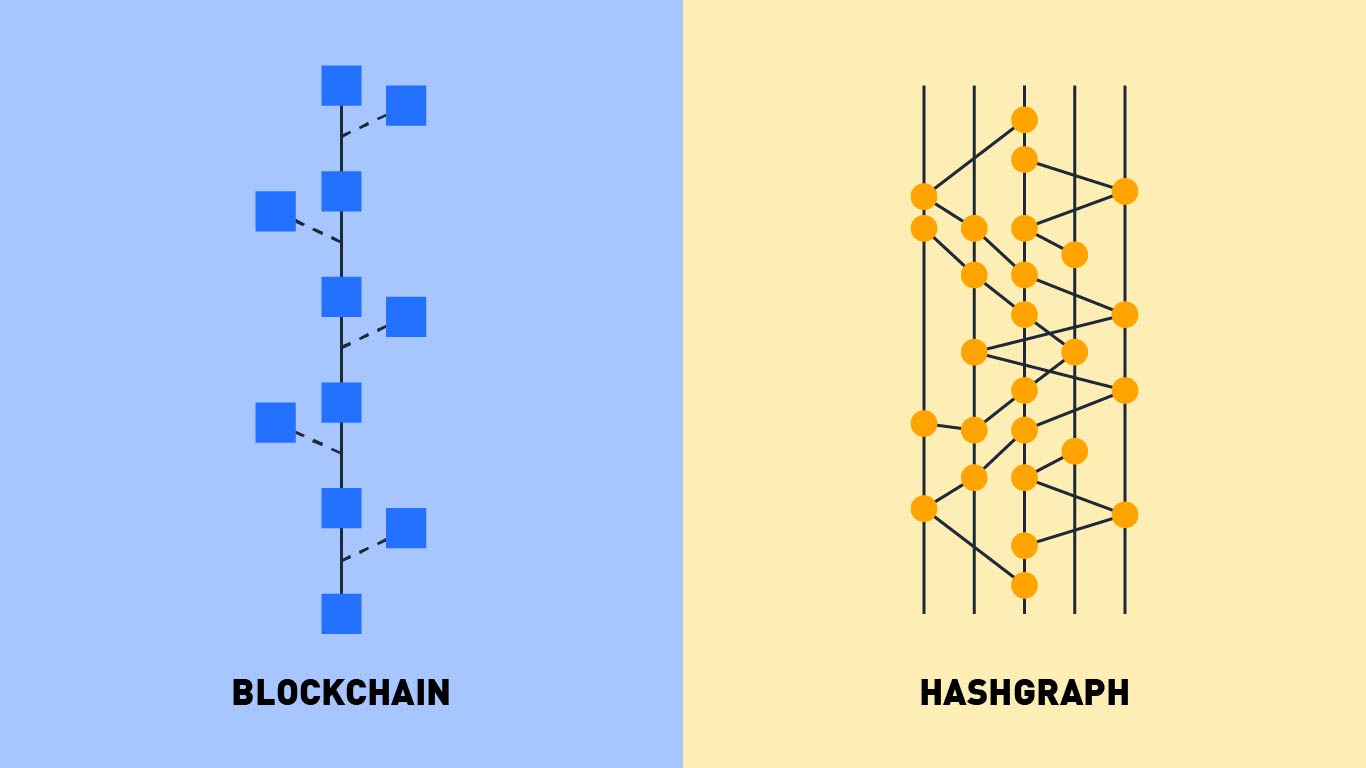
Distributed ledger space is a huge talking point for insurance – smart contracts, security, cost reduction, trust – it all points to a move on to this tech. BUT blockchains come with limitations by design and are, by their nature, slow. By allowing the ‘community’ to come to agreement and throw away the blocks they don’t agree on speed suffers. In today’s world SPEED is king and this is a huge barrier.

Even in the slow paced world of insurance, how many applications are there that can just do 5 transactions per second? None, I think. Hence blockchains have been all talk, to-date.

Many large companies across sectors are increasingly testing blockchain PoCs, but full adoption is constrained by core limitations such as transaction speed.

The hashgraph algorithm, invented by Leemon Baird, the co-founder and CTO of Swirlds, is a consensus mechanism based on a virtual voting algorithm combined with the gossip protocol to achieve consensus quickly, fairly, efficiently, and securely.

YAY – QUICKLY – speed could be solved, and we can adopt.

Hashgraph is an alternative to blockchain which is a first generation tech with severe constraints in terms of speed, fairness, cost, and security,” explained Mance Harmon, Co-founder of Swirlds and Hedera.”

For the layman what is Hashgraph? Well if you know what blockchain is (a distributed ledger technology) all about then this is relatively simple – Put simply it’s like Blockchain, but Hashgraph is without the limitations.

Under test, Hashgraph has performed well. Since time is a trade-off between throughput, latency, number of computers, and geographic distribution, the tests demonstrate these trade-offs very well without adding in another trade-off. For example, the results show 30 computers can achieve 50k transactions a second across 8 global regions in 3 seconds, or merely 1.5 seconds across 2k miles, or 0.75 seconds in a single region. This is great news and it could be time to open up PoC’s to this new tech.

These speeds mean that processors such as Visa can think of building it into their current network and transaction speeds.

The Hedera Hashgraph platform is architected to address the market of distributed applications. The vision provides an initial three sets of services as the platform evolves:

  1. Cryptocurrency as a service for support for native micropayments.
  2. Micro-storage in the form of a distributed file service that apps can use.
  3. Contracts.

Great – how do we play and pay? It works through a platform coin — when you make an API call to one of these three services, a micro-payment is made to the company.

The Hedera platform’s existing technical framework is capable of anti-money laundering and know your customer compliance which sits well for insurance. Regulatory compliance combined with enhanced security and speed could signal a time to start.

With a secure, fast, public ledger, the future could include micropayments and massive-scale distributed p2p insurance and other new models could be developed. Match distributed ledger technology and AI and the future is bright!

So, what to do now? We are looking at this tech to architecture our insurance models. We have been waiting until now owing to the fundamental issues in existing blockchain processes.

Let’s Grow Together

Explore Our Demo

In The Press

Insurance Innovation

03.23.2019
Insurance Industry Insurtech
blog formula

“The electric light did not come from the continuous improvement of candles.”

Oren Harari

Think about that.

Did the car engines come from constantly breeding better horses? Do airplanes fly by brilliantly flapping their wings?

No, these improvements in Light and Transport came about by the application of new technologies to known problems.

So how do we innovate in business? – We should be applying new technologies to our problems and making them more efficient.

Why should the insurance industry care about insurance innovation? Their products are about claims, how can you stop those with innovation? they are part of the product, right? Well, no, typically the insurance industry, as all businesses, cares about all its costs, the complete business model. The insurance industry has a very public metric, the ‘combined ratio’ or, I would say, the generally poor combined ratio. This metric should be the driver for all innovation

So what is The combined ratio? This is typically expressed as a percentage. A ratio below 100 percent indicates that the company is making an underwriting profit, while a ratio above 100 percent means that it is paying out more money in claims that it is receiving from premiums. The combined ratio is the adding up of all the costs of the industry.

This is the driver behind the insurance industry – its like the lap time of a F1 car – shed a 10th off here or there and you are in the lead and seen as the winner. Don’t work on the lap times and you are seen as going backwards.

The industry 2017 combined ratio was around 105% and in 2016 it was around 101%. Meaning that overall the insurance industry lost money from its core business in both years and 2018 will be similar.

So you would think that this would be a huge RED ALERT. No, this is business a normal.

The industry lives in a world of negative underwriter profits. This could be seen as very strange to other businesses. The industry struggles to focus on their main core driver because profits are driven from investing the insurance premiums – not driving the costs out. Imagine if F1 teams did not care about lap times? What would that race look like?

However this is the opportunity. Focus on the combined ratio, use Insurtech to drive costs down – the ability to affect this ratio in some way through speedier sales, smarter claims, better intelligence in underwriting, cost cutting through the business process, straight through processing, etc. They are huge wins to find.

The current business model is stuffed full of issues and problems that are all fully baked into many of the incumbent companies making change hard. Issues and Processes such as: any claim starts with a fraud review; the broker or agent selling the policy does not deal with the claim or carry any of the risk; the agent, broker, MGA, Underwriter, reinsurance business model is too expensive – each taking percentages to cover their costs; within in agents and broker businesses the pay policy fights against innovation; data is not collected in one place, its dispersed across the supply chain; the Policy is mainly a list of exclusions and complicated, it wants a court fight; its hard to get new risks covered or understood; micro policies are too expensive to process; and this is to name only a few of the core issues within the existing model.

You get the picture, insurance is not efficient.

The world of insure-tech is trying to come up with new ideas and models to improve upon existing structures. However, these tend to be around the edges of the problem. What is needed is a drains-up overhaul of the process and a move towards true digital insurance companies – ones that own the customer and all process straight through, from marketing to sales to claims and on to renewal. There are a few new companies emerging, ones that own the whole process, Ping An and ACKO.

The collection of data and the ability to speed up and take the friction out of the process is essential if insurance companies are actually going to make a constant profit from insurance and not rely on investment income. The aim needs to be a constant combined ratio of under 100% whilst keeping the policies priced sensibly. It is possible.

Data and the ability to process and learn from the data is essential. Insurance companies say they have loads of data. This is only partly true – they generally have very little transactional or process data covering the buying cycle of the policy and limited marketing data. They have very few insights into their customers, their motivations, etc. This is because many policies are sold through partner channels – for example if an agent is selling the policy – they don’t pass on or even collect data on customers who looked and did not buy – they certainly don’t find out why they looked and did not buy. This data is lost to the insurance buying cycle.

These simple examples explain why innovation is so hard. The larger companies are changing – they are going more direct, they are doing deals that embed insurance into products, they are starting to build their brands to be direct to the customer.

Where does this leave Insurtech? Tech companies need to build strong relationships with incumbents and in existing businesses need to innovate faster, the lap times are increasing and you don’t start or keep up you will be over taken by your smarter peers or new tech driven companies that get it right.


At MIC Global we are starting to build all the pieces to be a fully digital insurance company. From policy and insurance innovation, through distribution, policy lifecycle, claims automation and payment. This entails AI, machine learning, data analytics, bots and many other new tools. Today we are underway with photo recognition AI to scan data from images and other documents together with things like crash detection for cars or damage detection on mobile phones. These technologies are forming the foundations of a micro and multi service tech infrastructure.

We are able to develop and license these modules and we hope that we can partner with companies to do this.

Let’s Grow Together

Explore Our Demo