In The Press

Uber – New Opportunity or Just an Algorithm?

06.04.2019
Gig Economy
blog uber

The Gig economy is starting to see large companies become mature, these are led by Uber and the likes of AirBnB. Recently CNBC provided some great insight to what it is like to work in this new gig economy.

This shows the many ways people work in this new GiG economy, the ability that people can plug in and plug out of work, and make additional income from this and other jobs and platforms. How it fits with older people who often, despite the law, face discrimination etc.

This is also true for Uber and AirBnB – they can’t afford to focus on ONE business only, they want and need income from other areas. Uber has Uber Eats and AirBnB has their Experiences. These are other income areas for these companies and, just like their associates and drivers, they need to diversify. They need income from more than one good idea – to be more like Amazon and such companies, income from a range of products and services, to build an ecosystem. They are no different from the people who work with them via their Apps.

This is a message to us all – it seems that people, like companies, need to be diverse to be successful. To build an ecosystem of work and income. In todays economy companies and people need to be more alike.

Lifting a story from CNBC… Lama, a driver, uses three phones splayed across his dashboard (one for each app — Lyft, Uber and Juno.) “With Uber alone, you can’t make enough,” Lama said. He laughs at the fact that he’s considered an independent contractor….”The algorithm is our boss,” Lama said. “That’s the main guy.”

In the fourth quarter of 2018, Uber reports that 50 percent of its first-time Uber Eats customers were new Uber network users and that users of both Uber Eats and the rideshare app were more loyal than the average customer. The company also believes that less profitable partnerships with larger chains helps grow Uber’s audience, while giving drivers an opportunity for more work and compensation through Uber Eats. It’s all in the company algorithm.

What does this all mean for me and microinsurance or gig economy insurance? Well it means that it is no good having a monoline business focused on one area. To be a success and to leverage all your skills, leverage all the investments you have made, you need to be a multi-line company.

Here at MIC Global we are developing skills in several areas of insurance, sharing and gig economy, property loss, agriculture, weather and finance. We are using our skills in tech to manage these areas.

We have huge experience, for example, in motor claims. These are high volume low value claims and we are starting to implement Computer Vision to settle the insurance claim. Working with our clients we are developing photo image recognition Artificial Intelligence (AI) to process thousands of images in minutes rather than days.

The ability to use Computer Vision will be a core skill that we can leverage across all our insurance areas, the ability to automate a claim from AirBnB or Uber in the future will allow them to have the policies that they want at a cost the drivers can afford for example.

These custom built algorithms are at the centre of our tech and drive forward our ability to process high volume claims that are at the core of the gig and sharing economy.

Let’s Grow Together

Explore Our Demo

In The Press

Community Insurance

05.29.2019
Insurance Industry
blog communityinsurance

Millennials and Generation Z (GenZ) all have one thing in common – they don’t like the idea of buying insurance. Wait…; maybe this is across all generations? Plus, there are the labels – lazy, entitled, self-centred, disloyal and spoiled, but again is this not all generations at this young age?

Let’s not focus on this, let’s take a closer look at this new (ish) group of young adults, what shines out for me is that they are turning to borrowing, sharing, renting and hiring rather than buying. They want the ‘experience’ not the hassle of ownership. They want the ease. Cake & Arrow have been studying this group and their insights are interesting, not just for insurance but for all of commerce.

Millennials have grown up with a fully functioning computer in their hand and this drives everything.

While not all Millennials/GenZ are alike, there is one term defining their generation most might agree upon – the convenience generation. From on-demand taxi services, to on-demand food delivery and on-demand entertainment, these adults have opted for new levels of convenience unlike any other generation before them. Millennials and GenZ are choosing the convenience of Boxed and Amazon Prime over the prices of Costco and Sam’s Club.

How is this insurance industry responding? We see terms like “digital transformation,” “personalization,” and “on-demand,” these are the chosen jargon of the industry, used in industry events, panels, webinars, and reports across the world in an attempt to set clear objectives and guidelines for companies that want to stay relevant. What’s more, these terms have been portrayed by others as promising opportunities for those willing to embrace the journey.

But is this true? Do we really know that this is what drives a millennial insurance shopper? Or is that just the convenience of the ability to deliver on this in the context of what a company was doing anyway? Let’s make it digital??? This is the easy option, it’s got to mean something. Having a fancy front end, is this enough?

I believe that digital is a step in the journey but it not the end of the journey or even the point of the journey. The journey to me is much more than this, it is about making a difference and bringing out the true qualities of the industry, the fundamental reason for insurance and the difference it can make to those who take it out. These qualities are hidden and pushed way back in the dim past of the industry and the companies that form the industry. It’s the WHY of the industry, yet this seems lost.

For MIC Global, we are going to bring out this WHY. People talk about Peer to Peer insurance, but isn’t this what insurance is anyway? Why do people want insurance, why is it such a good thing? is the only reason you buy insurance is because you are forced to? Let’s look at a bit of the origins of insurance to find out the why it came around in the first place….

The first methods of transferring or distributing risk in a monetary economy, were practiced by Chinese and Babylonian traders in the 3rd and 2nd millennia BC. Chinese merchants traveling treacherous river rapids would redistribute their wares across many vessels to limit the loss due to any single vessel’s capsizing. The Babylonians developed a system and practiced by early Mediterranean sailing merchants. If a merchant received a loan to fund his shipment, he would pay the lender an additional sum in exchange for the lender’s guarantee to cancel the loan should the shipment be stolen or lost at sea.

It’s about looking at activities, groups and risks and providing cover for them should something go wrong. The whole point of community insurance is to build a community and allow large groups of the members to pay a little (insurance policy) towards the losses (claims) of the few.

This is the thing that seems lost today, users don’t see their part in the community giving benefits to the few. Todays insurance industry has drained all the feeling and warmth from their products. They forget the people paying for the few who claim. They forget to highlight how the easy payments of claims really benefit the ones who have suffered.

Microinsurance is all about the claim. Building in transparency to all customers. Not just the claims but the policies – allowing the communities that are built around our policies to see the claims and see how their money has helped support the community.

GenZ and Millennials want to be part of communities and helping support others and bring sense in to their lives. To grow and be relevant to these generations insurance needs to update itself and be more than digital, it needs to get back to its early existence and be part of the community, for the community.

Let’s Grow Together

Explore Our Demo

In The Press

Data Left Behind?

05.01.2019
Cyber Security
blog padlocks

vpnMentor’s research team recently (April 2019) discovered a hack affecting 80 million American households. Nothing new here. Just another massive data breach. Many new and many of the same people affected. Lets wait for the apology and move on……

However this time it’s a little different. There is a data security story with a twist – has the data been left behind?

Cybersecurity hacktivists Noam Rotem and Ran Locar discovered an unprotected database impacting up to 65% of US households. This is hosted by a Microsoft cloud server. The data base includes the number of people living in each household with their full names, their marital status, income bracket, age, and more.

So again – let us OUT the “corporate” stupid enough to leave it unprotected. This case is another step towards our trust dwindling a little bit more….. How much trust do you have left?

The research team is on the look out for these issues, they are looking after joe public interests by undertaking a huge web mapping project. They use port scanning methods to examine known IP blocks. This reveals open holes in web systems, which they examine for weaknesses and data leaks.

Usually, they can identify the company or person who owns the data base and they reach out to the owner to report the leak, and where possible, alert the people affected.

Their aim here is to build a safer and more protected internet, more power to them.

BUT, this time it’s different. Whilst the database includes identifying information for more than 80 million households across the United States, directly impact hundreds of millions of individuals. They cannot directly actually identify who set up the database and who is responsible for it.

Wait? …..What? You mean you can set up a Db on the cloud and not have it linked to you? You can get free space? This is a serious issue – lazy corporates who copy data for testing, PoC’s etc just setting it up and then leaving it behind after the project moves on or fails….no clean up.

It’s hosted on a cloud server, which means the IP address associated with it is not necessarily connected to its owner.

vpnMentor started calling on the public to help identify the database and close the leak. As an update of 30th April 2019 the database is no longer open to the public. Phew.

Following the publication of the vpnMentor report, Microsoft took the server offline. In a statement, Microsoft said, “We have notified the owner of the database and are taking appropriate steps to help the customer remove the data until it can be properly secured”. Microsoft has not revealed who owns the database.

This breach should to be fully reported. How can risk be tracked and identified if the company is allowed to get away with this? On their Cyber Policy renewal what would they say I wonder? We agree with vpnMentor – The 80 million families listed here deserve privacy. Help Them Here.

Let’s Grow Together

Explore Our Demo

In The Press

Just in Time?

04.09.2019
Insurance Industry
blog lorry

The USA federal Government under the Trump Presidency shows how countries actions can impose change and disruption for businesses. Not only their threats but actual actions mean companies need to plan and have back up plans particularly if they are part of or rely on an international supply chain, such as with just in time production. Political risk is a real issue.

With campaign promises to build a wall between the Mexico-United States border and continued threats to close Ports of Entry and to impose tariffs on foreign goods, organisations must now evaluate the damage that such events could have on their supply chain.

The efforts that the USA are going to deal with migration has created hours-long waits at the borders. The president’s tougher immigration policy is causing problems not just for immigrants but also has the potential to disrupt cross border trade.

As an example, approximately $177 billion of U.S. exports and $246 billion worth of imports make their way across the Mexico-United States border each year by truck, based on data from the U.S. Bureau of Transportation Statistics. Mexico is the third largest trading partner for the U.S. behind Canada and China. The automotive industry makes up a large portion of that trade. The U.S. also receives more than 40 percent of its fruit and vegetable imports from Mexico, according to a 2017 analysis from the U.S. Department of Agriculture.

With estimated wait times increasing to cross the border, the financial effect on companies is proving to be very damaging.

“The longer these delays get, the bigger the economic impact can be because businesses have to make monumental decisions.”

Gary Becker, Chief EconomistWashington D.C., based consulting firm Catalyst Partners

When the produce being transported is fruit and vegetables, any disruption in the supply chain can lead to substantial losses because they are perishable goods. In these situations how can businesses know what decisions to make and how to deal with these issues?

Our solution is to use detailed tracking of such perishable goods and other delicate products. We have a developed a tracker in partnership with an IoT company that can provide greater visibility into supply chain operations and allow users to make pro-active decisions relating to the condition of consignments.

When alerts of exceptional events are trigged – such as a shipment location, time at location, being dropped, opened, tilted or in this case, exposed to temperature or humidity outside of defined parameters, the user will be informed via our analytics portal. This auditable data can aid in resolving disputes as it allows everyone to identify the facts behind late and damaged goods.

In some cases, truckers may turn off their engines to save fuel meaning that the power supply to refrigerators will be turned off. Fruit and vegetables will soon expire if exposed to high temperatures for extended periods of time. In situations such as this, our users will be alerted in real-time of the rise in temperature which will give them the option to get in touch with the appropriate party to inform them of the risk being placed on the goods being transported.

Our solution puts shippers in control by enabling them to see what’s really happening and trending within their delivery network. Customer service will also be dramatically improved by enabling shippers and logistics suppliers to identify where delays and issues are happening and report back to customers.

The automotive supply chain is also heavily affected by these border crossings. Car parts tend to be manufactured in one country and then need to be shipped abroad to be matched with other parts. If delays become a common occurrence, organisations will need to start holding larger reserves of parts so they have enough products to keep their factories running. This will then undermine the benefits, and effect decision makers in the supply chain.

For businesses heavily dependent on goods arriving at the right place at the right time, reacting to supply chain failures can be just as important as preventing them. Our tracking solution is enabling those using just in time deliveries, specifically in the automotive sector, to react and be pro-active about failures in real time.

Tracking is part of the answer. Real time data and allows better decision making.

Let’s Grow Together

Explore Our Demo

In The Press

Blockchain or Hashgraph?

03.29.2019
Insurance Industry
blog blockchain hashgraph

So, there we were, in a planning meeting, thinking about how to implement a parametric insurance product, how to fully secure and automate it….and then someone mentioned Hashgraph! What?????

Just as I was getting tired of hearing “blockchain this…” and “Lemonade that…” we now have “Hashgraph”….

What is Hashgraph? Why was it so important to mention and for insurance?

Distributed ledger space is a huge talking point for insurance – smart contracts, security, cost reduction, trust – it all points to a move on to this tech. BUT blockchains come with limitations by design and are, by their nature, slow. By allowing the ‘community’ to come to agreement and throw away the blocks they don’t agree on speed suffers. In today’s world SPEED is king and this is a huge barrier.

Even in the slow paced world of insurance, how many applications are there that can just do 5 transactions per second? None, I think. Hence blockchains have been all talk, to-date.

Many large companies across sectors are increasingly testing blockchain PoCs, but full adoption is constrained by core limitations such as transaction speed.

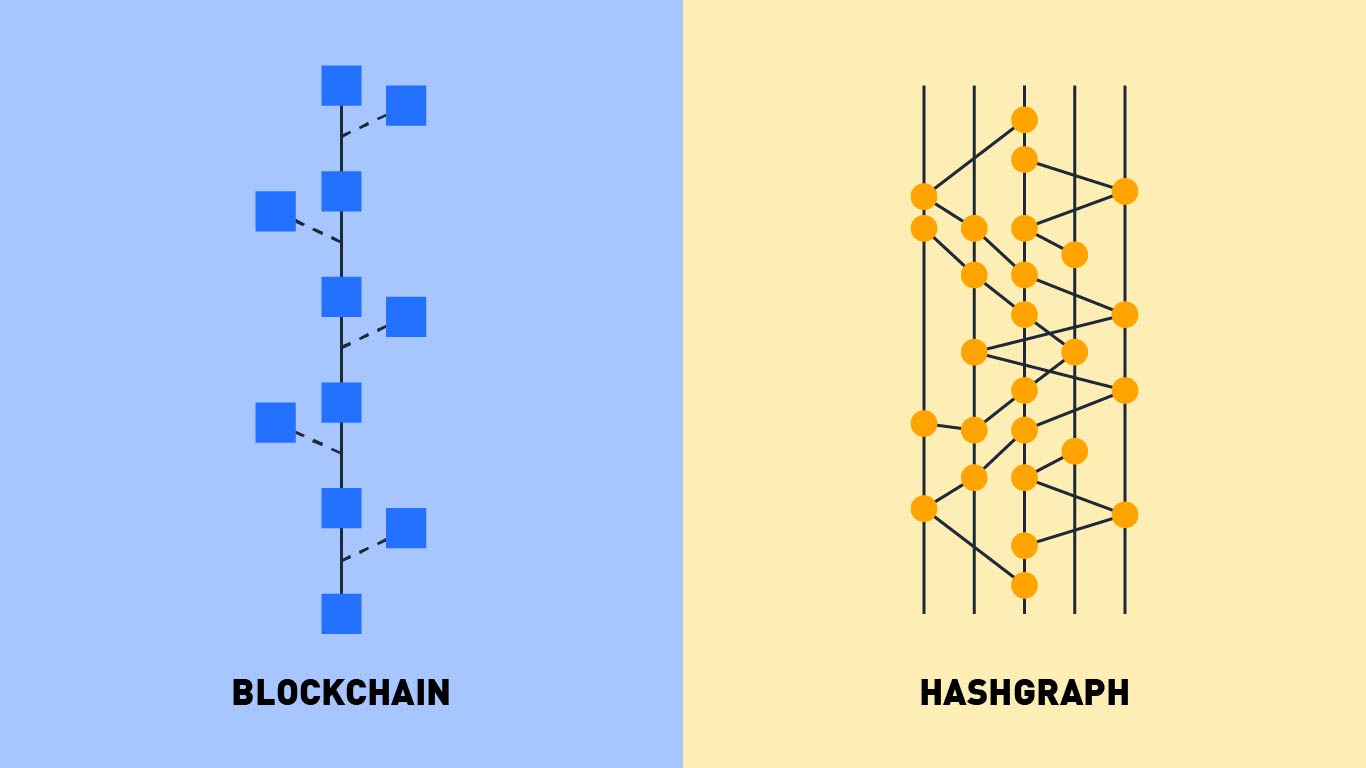
The hashgraph algorithm, invented by Leemon Baird, the co-founder and CTO of Swirlds, is a consensus mechanism based on a virtual voting algorithm combined with the gossip protocol to achieve consensus quickly, fairly, efficiently, and securely.

YAY – QUICKLY – speed could be solved, and we can adopt.

Hashgraph is an alternative to blockchain which is a first generation tech with severe constraints in terms of speed, fairness, cost, and security,” explained Mance Harmon, Co-founder of Swirlds and Hedera.”

For the layman what is Hashgraph? Well if you know what blockchain is (a distributed ledger technology) all about then this is relatively simple – Put simply it’s like Blockchain, but Hashgraph is without the limitations.

Under test, Hashgraph has performed well. Since time is a trade-off between throughput, latency, number of computers, and geographic distribution, the tests demonstrate these trade-offs very well without adding in another trade-off. For example, the results show 30 computers can achieve 50k transactions a second across 8 global regions in 3 seconds, or merely 1.5 seconds across 2k miles, or 0.75 seconds in a single region. This is great news and it could be time to open up PoC’s to this new tech.

These speeds mean that processors such as Visa can think of building it into their current network and transaction speeds.

The Hedera Hashgraph platform is architected to address the market of distributed applications. The vision provides an initial three sets of services as the platform evolves:

  1. Cryptocurrency as a service for support for native micropayments.
  2. Micro-storage in the form of a distributed file service that apps can use.
  3. Contracts.

Great – how do we play and pay? It works through a platform coin — when you make an API call to one of these three services, a micro-payment is made to the company.

The Hedera platform’s existing technical framework is capable of anti-money laundering and know your customer compliance which sits well for insurance. Regulatory compliance combined with enhanced security and speed could signal a time to start.

With a secure, fast, public ledger, the future could include micropayments and massive-scale distributed p2p insurance and other new models could be developed. Match distributed ledger technology and AI and the future is bright!

So, what to do now? We are looking at this tech to architecture our insurance models. We have been waiting until now owing to the fundamental issues in existing blockchain processes.

Let’s Grow Together

Explore Our Demo

In The Press

Insurance Innovation

03.23.2019
Insurance Industry Insurtech
blog formula

“The electric light did not come from the continuous improvement of candles.”

Oren Harari

Think about that.

Did the car engines come from constantly breeding better horses? Do airplanes fly by brilliantly flapping their wings?

No, these improvements in Light and Transport came about by the application of new technologies to known problems.

So how do we innovate in business? – We should be applying new technologies to our problems and making them more efficient.

Why should the insurance industry care about insurance innovation? Their products are about claims, how can you stop those with innovation? they are part of the product, right? Well, no, typically the insurance industry, as all businesses, cares about all its costs, the complete business model. The insurance industry has a very public metric, the ‘combined ratio’ or, I would say, the generally poor combined ratio. This metric should be the driver for all innovation

So what is The combined ratio? This is typically expressed as a percentage. A ratio below 100 percent indicates that the company is making an underwriting profit, while a ratio above 100 percent means that it is paying out more money in claims that it is receiving from premiums. The combined ratio is the adding up of all the costs of the industry.

This is the driver behind the insurance industry – its like the lap time of a F1 car – shed a 10th off here or there and you are in the lead and seen as the winner. Don’t work on the lap times and you are seen as going backwards.

The industry 2017 combined ratio was around 105% and in 2016 it was around 101%. Meaning that overall the insurance industry lost money from its core business in both years and 2018 will be similar.

So you would think that this would be a huge RED ALERT. No, this is business a normal.

The industry lives in a world of negative underwriter profits. This could be seen as very strange to other businesses. The industry struggles to focus on their main core driver because profits are driven from investing the insurance premiums – not driving the costs out. Imagine if F1 teams did not care about lap times? What would that race look like?

However this is the opportunity. Focus on the combined ratio, use Insurtech to drive costs down – the ability to affect this ratio in some way through speedier sales, smarter claims, better intelligence in underwriting, cost cutting through the business process, straight through processing, etc. They are huge wins to find.

The current business model is stuffed full of issues and problems that are all fully baked into many of the incumbent companies making change hard. Issues and Processes such as: any claim starts with a fraud review; the broker or agent selling the policy does not deal with the claim or carry any of the risk; the agent, broker, MGA, Underwriter, reinsurance business model is too expensive – each taking percentages to cover their costs; within in agents and broker businesses the pay policy fights against innovation; data is not collected in one place, its dispersed across the supply chain; the Policy is mainly a list of exclusions and complicated, it wants a court fight; its hard to get new risks covered or understood; micro policies are too expensive to process; and this is to name only a few of the core issues within the existing model.

You get the picture, insurance is not efficient.

The world of insure-tech is trying to come up with new ideas and models to improve upon existing structures. However, these tend to be around the edges of the problem. What is needed is a drains-up overhaul of the process and a move towards true digital insurance companies – ones that own the customer and all process straight through, from marketing to sales to claims and on to renewal. There are a few new companies emerging, ones that own the whole process, Ping An and ACKO.

The collection of data and the ability to speed up and take the friction out of the process is essential if insurance companies are actually going to make a constant profit from insurance and not rely on investment income. The aim needs to be a constant combined ratio of under 100% whilst keeping the policies priced sensibly. It is possible.

Data and the ability to process and learn from the data is essential. Insurance companies say they have loads of data. This is only partly true – they generally have very little transactional or process data covering the buying cycle of the policy and limited marketing data. They have very few insights into their customers, their motivations, etc. This is because many policies are sold through partner channels – for example if an agent is selling the policy – they don’t pass on or even collect data on customers who looked and did not buy – they certainly don’t find out why they looked and did not buy. This data is lost to the insurance buying cycle.

These simple examples explain why innovation is so hard. The larger companies are changing – they are going more direct, they are doing deals that embed insurance into products, they are starting to build their brands to be direct to the customer.

Where does this leave Insurtech? Tech companies need to build strong relationships with incumbents and in existing businesses need to innovate faster, the lap times are increasing and you don’t start or keep up you will be over taken by your smarter peers or new tech driven companies that get it right.


At MIC Global we are starting to build all the pieces to be a fully digital insurance company. From policy and insurance innovation, through distribution, policy lifecycle, claims automation and payment. This entails AI, machine learning, data analytics, bots and many other new tools. Today we are underway with photo recognition AI to scan data from images and other documents together with things like crash detection for cars or damage detection on mobile phones. These technologies are forming the foundations of a micro and multi service tech infrastructure.

We are able to develop and license these modules and we hope that we can partner with companies to do this.

Let’s Grow Together

Explore Our Demo

In The Press

Insurance, Blockchain & Oracles

02.12.2019
Insurance Industry
blog blockchain oracle

Here at MIC Global we continue to explore blockchain, the world of “a smart contracts”. It is our current belief that ‘smart contracts’ will be the core insurance uses-case for blockchain. Why is this? Because the MAIN thing that people buy when they take out insurance is a contract. Nothing more – insurance is a contract to pay if a set of events occur in the future and is within the bounds of said contract.

Today, there is nothing wrong with the contracts that insurance companies use, well they are wordy and fully of small print, allow for ambiguity and generally need lawyers and administrators to navigate the many escape routes that are built in. So to introduce ‘smart contracts’ into the process takes tech and investment – two things that the insurance industry is slow to do.

Insurance contracts should, on the face of it, be very simple. They should ensure that each party is dealt with fairly and each party receives and gives what they thought when it was signed. There are many instances where insurance companies fight claims and slow down payments. This is where smart contracts can fulfil a need. Welcome to the world of smart contracts, these contracts don’t leave the chance for interpretations. For insurance they enable so many benefits.

The use of these contracts are now linked to the rise of blockchain and a change in technology and process that is still very young for many companies and, in many cases, at a pre-Proof of Concept (POC) stage in insurance companies.

The use of blockchain in insurance is the tech game changer that is needed within the industry to bring straight through processing advantages to insurers and brokers. Smart contracts will, eventually, be used for sharing economy, gig economy, IoT and platform insurance. Making the process very transactional. Making insurance transactional.

The main idea behind the use of ‘smart’ in smart contracts is to use tech coding to determine the relations and obligations between parties and automatically administer these clauses and relationships. The contracts make possible to exchange money, property, shares, or basically anything of value in a transparent and non-conflicting way.

Basically, the smart contracts have the trust built in. Add this to the idea of a decentralized blockchain network and you can start to see the power of these contacts within the insurance industry, especially around parametric and transactional insurance. The conflict of ambiguity is removed. The power of speed and volume enhanced.

The term “smart contract” is widely associated with Ethereum or IBM. Currently the Ethereum smart contracts are the most popular. However, it is possible to create smart contracts on other Blockchain platforms.

In 2018, a US Senate report said: “While smart contracts might sound new, the concept is rooted in basic contract law. Usually, the judicial system adjudicates contractual disputes and enforces terms, but it is also common to have another arbitration method, especially for international transactions. With smart contracts, a program enforces the contract built into the code.”

Other forms of smart contracts are Ricardian contracts. This form of contract maybe be more relevant to the insurance industry. A definition, from its creator, says a Ricardian contract is “a digital contract that defines the terms and conditions of an interaction, between two or more peers, that is cryptographically signed and verified. Importantly it is both human and machine readable and digitally signed”. This definition makes it very usable for insurance where both parties may want to use the contract from time to time.

A Ricardian contract registers a legally valid and digitally connected document to a certain object or value. A Ricardian contract places all information from the legal document in a format that can be executed by software. In this way it is both a legal agreement between parties and a protocol that integrates an agreement offering a high level of security because of cryptographic identification.

With a smart contract, a person could, for instance, have a hurricane insurance policy contract that is encoded in the blockchain in the form of a set of rules.

In case of the hurricane coming, the smart contract could then automatically transfer the claim money to the beneficiary. The Insurer may provide additional constraints, such as enabling the transfer only when the hurricane reaches certain intensity and tracks to a location within certain parameters etc.

Since smart contracts’ conditions are based on data stored in the blockchain, they need only to rely on external services, which take data from the “real” world (e.g. from hurricane tracking and location tech) and push them to the blockchain (or vice versa). These services are referred to as “oracles”. By considering this example, an oracle could inspect the presence of a hurricane’s track and intensity to identify whether the person/company (Insured) is eligible for a pay-out. This eligibility could also test against claims materials instantly read on the blockchain such as invoices or other records. This would then trigger an instant, automatic, payment.

Let’s Grow Together

Explore Our Demo

In The Press

Hacking With a Pringles Tube, Remember?

02.01.2019
Cyber Security
blog pringles

Do you remember when the news was hacking wireless networks with a Pringles tube?

Back in the mid 2000’s empty cans of Pringles crisps could be helping malicious hackers spot wireless networks that are open to attack. A security company, i-sec, demonstrated that a directional antenna made with a Pringles can significantly improves the chances of finding the wireless computer networks being used in London’s financial district, at the time the informal survey carried out by i-sec using the homemade antenna found that over two-thirds of networks were doing nothing to protect themselves.

Jump on 10 years and what do we have today?

Drones! We have a drone being used in hacking, WIRED has a great story on how it works. The ability to compromise a ‘air-gapped’ computer, the safeguard of separating highly sensitive computer systems from the internet to quarantine them from hackers.

A group of researchers at Ben-Gurion University in Beersheba, Israel cybersecurity lab has devised a method to defeat “air gap” computers.

This video shows the drone taking off from a car park.

In ten years or so we have moved from a hacking with Pringles Tube to a Drone – this shows amazing progress!!

Let’s Grow Together

Explore Our Demo

In The Press

Small Business Data Breaches

02.01.2019
Cyber Security
blog cybersecurity

Do you think your business is too small for a hacker to break in and take data? Is data breach a concern for your business? Banks were said to be ‘too big to fail’ in 2008. Today the big risk is for hacking and crime, many small businesses believe they are ‘too small to be a target’.

In August and September 2018, property and casualty insurer Chubb completed a survey with YouGov in Singapore to gauge their attitude to cyber risks.

“Some SMEs believe they are too small to be targeted by cyber criminals or any internal issues will not greatly impact them. In effect, they think they are “too small to fail”. However, every report, survey or set of statistics on cyber events tell us that all businesses are exposed, whether big or small.

“Structured risk management methods and strategies are largely nonexistent as most SME owners seek to maximise profitability and growth. I see this is an opportunity for insurance companies and brokers to better inform their clients,”

Andrew Taylor cyber underwriting manager, Chubb Asia Pacific

Securing your small business from data breaches is good for you and good for your clients. Many small businesses work for larger businesses and the supply chain is going to gather more focus. Supply chain and audit is growing in focus and companies need to start connecting their whole supply chain with an audit support function to highlight risk and correction. Do companies know the strength of the companies within their supply chain? Especially cyber risks? Hacking small businesses can be an easy way to literally allow a hacker to walk into a larger company.

Let’s Grow Together

Explore Our Demo

In The Press

Should You Secure Your Data?

01.16.2019
Cyber Security
blog securedata

We are told that we should secure our data against data breaches and make sure we don’t tell people and companies un-necessary information about ourselves. Just 15 years ago we were told to shred our old post and envelops for fear of thieves going through our bins.

Yet on the other hand, today people will tell you that there’s no point as all our data is out there, its been breached and hacked already, sold multiple times, and anyway we post the craziest details all over Facebook, so why secure your data against a data breach now? Why stop sharing everything?

This last point of view comes from the fact that many large corporations don’t seem to care about your data as much as you may have hoped.

The well-known password security company Dashlane has compiled a list of the top 20 data breaches of 2018. If you thought that the British Airways case was bad take a look at the list, it only just made the list at number 20.

The list shows that just under 3 billion data records were stolen. And this was ONLY 2018. The chances that your data is not on this list is quite small – somewhere some part of your data is already compromised. Especially if you add the many smaller hacks of 2018 and those of previous years.

We are heading into 2019 and I am wondering is securing my data worth it today, since its already out there?

I take the view that it is. Hackers don’t know what my new passwords are, things that I have added today, things I have updated etc. My profile changes all the time. I am working to actively make my historical data out of date and not useful. Change passwords, stop adding sensitive data to social media, only give data that companies need to interact with them. For example, why give a correct Date of Birth unless is essential? Your main email – why give that? Your mobile number – why give that? Your correct zip code – why give that? Unsubscribe as soon as it’s not useful, why not?

Each bit of data given should be questioned and if you think its not important to the actual transaction then don’t give the data. That hotel site, why does it need your Date of birth or your main email address? We have responsibilities too.

Companies take more data than they need and then don’t secure it as we have seen. I understand that new platforms are trying to automate ‘trust’ by vetting guests or workers before they use the platform so that providers and users can trust the site. But the platform must then be responsible for the data. Again the hotel is a good example – You can pay cash at a hotel and they don’t know anything much about you…. AirBnB on the other hand needs to know your complete verified identity just to sign up and book. The duty of care here for data is completely different.

Looking forward to December 2019, I wonder what the list will look like, one thing for sure it won’t be an empty list! Ask any security expert today what the biggest risk in December 2019 will be and they wont know – hacking threats change and update all the time. Is it finally time to look at information insurance? To buy that data recovery policy? To ask your broker about your business insurance?

Let’s Grow Together

Explore Our Demo