In The Press

MIC Global and inDrive Expand Insurance Partnership to 18 Countries, Extending Protection to Millions of Drivers and Passengers Worldwide 

08.20.2026
Community Insurance Industry Micro Insurance Press Release Stays Thought Leadership
cropped mic global favicon

From Three Countries to Eighteen

What Insuring the World’s Drivers Actually Takes

New York, Country — Aug 19th 2026 – MIC Global, a leading provider of parametric micro insurance for the gig economy, and inDrive, the global mobility and delivery platform, today announced the expansion of their partnership to 18 countries. The trip-level policy covers drivers and passengers against several risks, including medical expenses in the event of an accident during a ride. 

inDrive is a company built on a simple conviction: that fairness and technology can coexist, and that platforms can serve people rather than extract from them. On New Year’s Eve 2012, temperatures in Yakutsk, Siberia, dropped to -45°C. Local taxi companies tripled their prices. Stranded residents organized rides and agreed on fair fares via social media – and from that act of collective defiance, inDrive was born. Today it operates across more than 1200 cities in 48 countries. 

It is exactly the kind of partner MIC Global was built for. 

The Gap Nobody Was Closing

Traditional insurers aren’t designed for the gig economy: their products assume static risks, predictable schedules, annual period, and single geographies. A market place app across different continents and countries with 1000, s of drivers completing billions of trips a year, in towns and cities where out-of-pocket medical costs can be catastrophic, didn’t fit the model. 

MIC Global is made for this. From the ground up, they are built for short duration, event driven, automated claims and embedded insurance.  MIC consumes the data, designs the insurance around the platform, making these new events insurable and most importantly beneficial to the platform and their customers. The triggers are binary and platform verified: the trip either happened or it didn’t. No form, no underwriter judgment call, claims adjudicated on the date using data points the platform already holds. This is the new insurance model – this model is closing the gap.

The Partnership

The partnership launched in 2024, when MIC Global covered inDrive across three countries with a policy covering drivers and passengers, operative only during an active trip booked through the inDrive app. 

inDrive was founded to challenge injustice. MIC Global was founded to deliver a safety net for short term income loss for workers globally. The partnership allows each to do what it does best: MIC Global owns the underwriting, manages compliance, and handles claims, leaving inDrive to focus on connecting drivers and passengers at fair prices, in communities that need it most. 

Every listing and location faces unique challenges. Rather than offering one-size-fits-all coverage, this insurance offers a payout unique to each listing based on past earnings, and is calculated using the listing’s historical average earnings. This structure protects hosts at the level of protection they need, right when they need it most.

The Challenges of going Global 

Scaling from three countries to eighteen in under two years is not just a technology challenge – it is a compliance, actuarial, claims, and relationship challenge, and it is hard. 

Every market has its own regulatory framework around insurance. MIC ensures full compliance with local insurance regulations compliance in every market while maintaining a single, consistent underwriting spine across the portfolio. 

Build the infrastructure once and make it repeatable: standard policy architecture per vertical, bespoke wording and actuarial basis per geography, and a reinsurance structure providing capital across all markets at once. Covering local issues globally, currency risk, aggregate limits, bordereaux reporting, loss ratio monitoring, and sanctions screening all be managed per country, simultaneously.

Mike Eksteen, Senior Vice President and Chief Business Officer of MIC Global, said

We fast-track innovation. It starts with a deep dive into our partner’s business – how they operate, where their risk sits, what their people actually need. Once we understand that, our AI-enabled technology and underwriting innovation let us package a protection solution built precisely for it: standard policy architecture per vertical, local licensing and actuarial work per market, reinsured through Lloyd’s and MIC Re. Built once, ready everywhere. So, when inDrive moved into a new country, we moved with them. That’s how our partners grow and thrive: protection that scales as fast as the platform does.

Andries Smit, Chief Growth Business Officer, inDrive

inDrive was built on the idea that platforms should serve people, not extract them. Extending real financial protection to drivers and passengers across 25 countries is that principle in practice. For a driver completing multiple trips a day in a market where a serious accident could mean financial ruin for their entire family, this is not a marginal product, its a safety net.

About MIC Global

MIC Global is an AI-enabled global protection layer built to close the world’s income protection gap. Our MiIncome suite of parametric income protection products are live in over 25 countries, fully embedded into some of the world’s largest platform partners. By pairing AI-enabled technology with underwriting innovation – MIC’s standard policy architecture per vertical, local licensing and actuarial expertise per market, reinsured through Lloyd’s and MIC Re – MIC Global delivers protection that scales as fast as its partners do.

About inDrive 

inDrive is a global mobility and delivery platform. The inDrive app has been downloaded over 400 million times, and has been named the second most downloaded ride-hailing app. In addition to ride-hailing, inDrive provides an expanding list of services, including intercity transportation, delivery, and financial services. In 2023, inDrive launched New Ventures, a venture and M&A arm. 

inDrive operates in over 1200 cities in 48 countries. Driven by its mission to challenge Injustice through fair choices, inDrive is committed to having a positive impact on people’s lives. It pursues this goal both through its core business, which supports local communities via a fair pricing model, and through the work of its impact programs.  

For more information visit www.inDrive.com  

Media Contacts 
press@micglobal.com 

[View the official press release on PR Newswire]

Let’s Grow Together

Explore Our Demo

In The Press

Airbnb Launches Earnings Protection in Partnership with MIC Global

06.03.2026
Community Insurance Industry Micro Insurance Press Release Stays Thought Leadership
AirbnbPhotoHeader

Key Takeaways

  • Earnings Protection is an optional paid insurance that covers income loss from unexpected events, based on past earnings.
  • Available in 45 US states for hosts who have 1 year of experience and 50 booked nights in the past 12 months.

Protecting earnings for hosts when the
unexpected occurs

Hosting on Airbnb provides a vital source of income for hundreds of thousands of Americans. Last year alone, the typical host in the US earned over $15,500. But when unexpected events—like a winter blizzard, a natural disaster, or a local emergency—force a temporary pause in hosting, the financial impact can be significant.

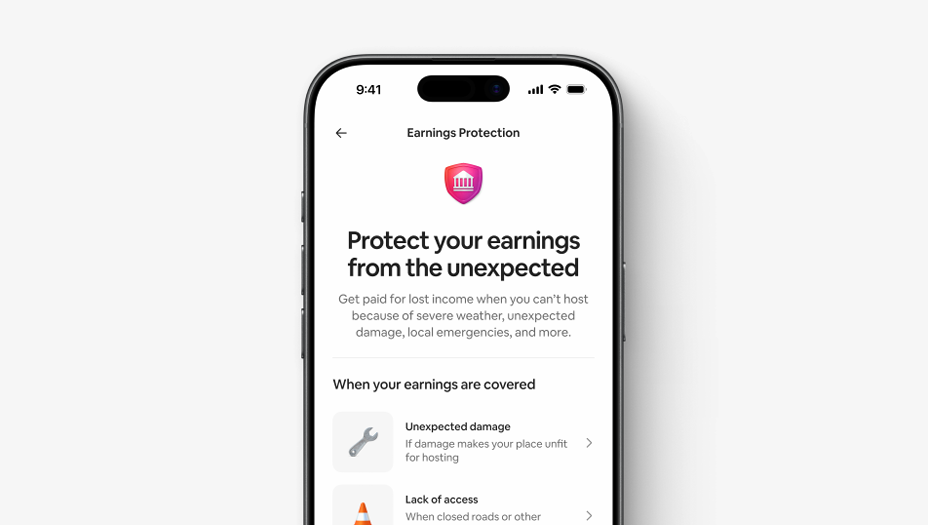
We’re introducing Earnings Protection, a new insurance plan designed to give US hosts a financial safety net when crises occur. Currently available for purchase in 45 states in the US —with plans to expand to all 50 states in early 2027—Earnings Protection provides a payout as supplemental income when external factors prevent hosts from welcoming guests. Whether it’s a hurricane disrupting a busy season or severe property damage impacting the ability to host, this plan helps hosts avoid bearing the full financial impact of interrupted hosting activity.

This new insurance plan, offered in partnership with MIC Global, was created in direct response to feedback from the host community, and serves as a complementary addition to AirCover for Hosts, Airbnb’s built-in protection program included automatically with every listing.

Custom coverage for eligible listings

Every listing and location faces unique challenges. Rather than offering one-size-fits-all coverage, this insurance offers a payout unique to each listing based on past earnings, and is calculated using the listing’s historical average earnings. This structure protects hosts at the level of protection they need, right when they need it most.

Some of our very best hosts have shared how stressful it can be when something completely out of their control — such as extreme weather conditions — makes it impossible for them to host, and their income is immediately impacted,” said Sui Lin Cheong, Airbnb’s Vice President, AirCover and Insurance Operations. “We partnered with MIC to design this first-of-its-kind product to give our hosts extra peace of mind so they can focus on rebuilding their business and doing what they love: hosting again.

To qualify for the program, hosts must:

  • Have 5 or fewer listings, with over 50 nights reserved on a listing in the past year.
  • Live in the US, with a listing in any state but Indiana, Maine, Missouri, New Jersey, and New York.
  • Add ACH (direct deposit) as one of the payout methods, with currency set to USD.
  • Hosted their first reservation at least one year ago.

For MIC Global, our partnership with Airbnb represents the convergence of our embedded distribution model, global reinsurance capacity, and the kind of parametric innovation that turns insurance from a promise into a real-time financial safety net for the people who depend on it most

 — said Jamie Crystal, MIC Global Chief Executive Office

Eligible hosts can explore their customized coverage options and see their quote starting
today directly within their earnings dashboard.

Let’s Grow Together

Explore Our Demo

In The Press

The Three-Level Insurance Flywheel

05.28.2026
Insurance Industry Micro Insurance Press Release Thought Leadership
the-three-level-insurance-flywheel

Why MIC Global’s growth model compounds instead of plateaus 

By Harry Croydon, Co-Founder, President & COO.MIC Global

Most insurance companies run on a pipeline. Leads come in, policies go out, renewals follow. Growth is a function of headcount, marketing spend, and distribution relationships — all of which cost money and plateau over time. The model works. But it does not compound. 

The problem with the pipeline 

Traditional insurance grows linearly. Add a salesperson, write more policies. Increase the marketing budget, generate more leads. The pipeline has no answer for the growth rates the best digital platforms post: fintechs doubling their user base in twelve months, gig economy operators crossing borders in a quarter. 

MIC Global was built to serve those platforms. To do that seriously, our growth model had to match theirs. The pipeline was never an option. 

The flywheel idea: why three levels

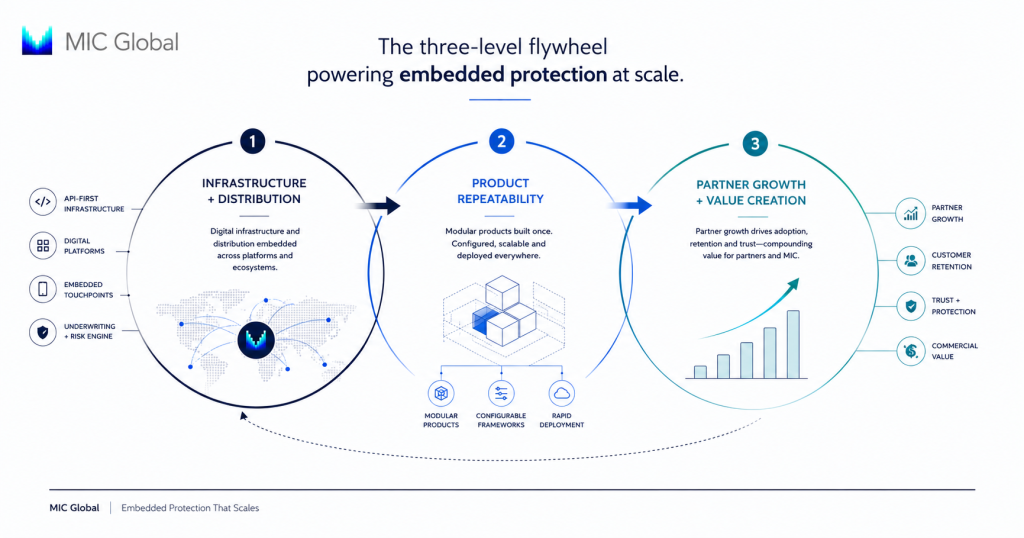
A flywheel is a growth model built on momentum. Each action adds energy to a spinning wheel. The heavier and faster it turns, the less effort each subsequent push requires. Amazon mapped this principle in its earliest shareholder letters: more customers attract more sellers, more sellers attract more customers, lower costs from scale attract more of both. The wheel becomes self-reinforcing. 

Most businesses that adopt a flywheel model operate at two levels. MIC Global operates at three. The third level is where the economics change.

Wheel one: capacity and partners

The first wheel connects our Lloyd’s Coverholder status and reinsurance relationships which is our underwriting backbone to a growing network of digital distribution partners: platforms, fintechs, lenders, and gig economy operators across the US and globally. 

The logic is direct. The more partners we add, the more data we accumulate. More data means better underwriting, faster product development, and sharper pricing. Better products attract more partners. The wheel starts turning. 

MiIncome™ is the engine here: embedded income protection designed to sit natively inside a partner’s platform. Not bolted on. Not a redirect. Protection felt as a product benefit, invisible as a policy. Partners including inDriveQICRhino, and ASNA are part of this wheel today, each adding momentum. 

One thing that keeps the first wheel nimble: MIC Global carries no long-tail catastrophe exposure, no large-limit liability. The platform is built to move fast. 

Wheel two: products and scale

The second wheel engages as the first accelerates. As our partner network grows and our data deepens, we develop and deploy new products at a pace and cost that traditional insurance infrastructure cannot match. 

MiIncome™’s trigger architecture makes this possible. Involuntary job loss. Natural hazard income disruption. Gig worker accident cover. Trip cancellation. Weather inconvenience. Each trigger is modular, repeatable, and deployable across new markets in a fraction of the time a traditional product build requires. 

Every product we add strengthens what we can offer a partner. Every market we enter expands the compliance and fronting network they benefit from. A partner launching in the US today can expand into India, Latin America, or Southeast Asia with MiIncome™ already positioned to support that move. 

The second wheel also collects data at scale: claims data, behavioural data, loss ratios by trigger type and geography. That feeds back into underwriting, pricing, and product design. The flywheel tightens. 

Wheel three: partner growth compounds our growth

This is the level that makes MIC Global’s model different from any two-level flywheel, and the reason we believe our growth potential is comparable to the platform businesses we serve. 

The partners we work with are not passive distributors. They are flywheel businesses in their own right — platforms actively growing their user bases, deepening their ecosystems, and expanding into new markets. And this is where our model does something a conventional insurance relationship cannot: we help them do it. 

We do not just grow when our partners grow. We help them grow. Embedded income protection — properly positioned — becomes a product feature that improves acquisition, deepens retention, and extends customer lifetime value. When a partner integrates MiIncome™, they are not bolting on an insurance policy. They are adding a commercial asset. Their acceleration adds to ours. Ours feeds back into theirs. The right partners do not slow the wheel. They spin it faster. 

The first wheel is running. The second is accelerating. The third is what makes the whole model self-reinforcing — for us, and for the platforms we work with.

Why now 

The income protection gap is not a niche problem. According to the International Labour Organization, more than 4 billion people globally have no meaningful social protection coverageIn the US alone, more than half of adults cannot cover three months of expenses from savings. The gap is structural. Existing solutions are priced and distributed for a different era. The opportunity to reach underserved people through digital platforms they already trust has never been more accessible. 

Traditional insurers were not built to close this gap. Their distribution models, product timelines, and cost structures were designed for a different customer relationship — one that reaches far fewer people, at far higher price points. 

MIC Global was built for this gap: with the flywheel architecture, the AI infrastructure, and the partner network to make embedded income protection a standard feature of digital life. 

The first wheel is running. The second is accelerating. The third is what makes it self-reinforcing. 

The right embedded protection partner should make your platform stickier, your customers more loyal, and your proposition harder to replicate. If that sounds like the right conversation, let’s have a chat. 


About the Author

Harry Croydon is Co-Founder, President and COO of MIC Global. Connect with Harry on LinkedIn

Let’s Grow Together

Explore Our Demo

In The Press

Protecting Income & Safety Globally: MIC Global’s Embedded Microinsurance Services Serve Clients in the Digital World

03.13.2025
Micro Insurance MiIncome Press Release
blog income safety
USA Today logo
Photograph of Indian male driver driving car with passenger

At the center of MIC Global (MIC), a full-stack embedded microinsurance provider, is a commitment to empowering underserved consumers and businesses through a comprehensive suite of products built for the digital world. Embedded at the point of sale, MIC’s solutions address global insurance protection gaps and other industry challenges, acting as a lifeline for those affected by unexpected loss of income, identity theft, and more.

With a B2B2C model, MIC relies on strategic partnerships, embedding parametric microinsurance triggers that help individuals survive even the most financially debilitating circumstances. Tech-enabled and co-founded by insurance and technology experts Harry Croydon, COO, and Jamie Crystal, CEO, the company’s products are underwritten via Lloyd’s Coverholder and MIC Re, backed by Lloyd’s and A-rated carriers, and integrated via APIs.

Though its technology is complex, MIC’s mission is simple: to make insurance as easy and accessible as modern-day food delivery or streaming. Distributed through platform companies, the firm achieves this goal through collaboration, protecting specific needs unserved by traditional methods. Its focus is enhancing gig economies and everyday business dynamics with trust, transparency, and peace of mind.

Reflecting on MIC’s inspiration, Croydon shares, “There are many reasons why conventional insurance products don’t fulfill all needs. Often, they aren’t embedded in the right place on the customer journey, resulting in a lack of trust and, what’s arguably worse, a lack of understanding of why insurance is so important. As it is, insurance is difficult to sell. After all, you don’t need it to carry on living, but if something happens, you end up wishing you had it.”

According to the MIC founders, one of the most prominent challenges of the industry is legacy systems. With delays and a lack of easy access to products and other services, many people believe insurance is a maze of complexities nearly impossible to navigate. “Recent years have brought an influx of shiny, convenient apps where everything is on demand,” adds Crystal. “For us, it was obvious: insurance needed to be digital, too.”

MIC’s products, including MiIncome™, MiIncident™, and more, aim to solve another challenge: complicated, all-inclusive policies. Traditional selling techniques center on more expensive policies that include diverse potential scenarios. To make insurance less of a financial burden, MIC unbundles clauses, offering more targeted packages that address only the unique risk factors and needs of every client. 

Designed to cover unexpected loss of income, MiIncome™ is MIC’s flagship product. After noticing a global gap in effective and trusted protection when faced with financial diminution, the company honed in on the product, refining it to meet the needs of employees worldwide. Whether a student working part-time to afford rent and education, a single parent working overtime to pay the bills, or a family with monetary responsibilities, unexpected curveballs can disrupt life as one knows it. MiIncome™ is a lifeline at a time of need, providing a safety net that helps clients protect their legacies and support their and their families’ livelihoods. 

Currently operating in more than 12 countries, MIC ensures all customers can reach security through its global distribution partners. While insurance companies benefit from an added layer of trust and transparency, MIC broadens its impact and cements its position in the marketplace. These collaborations are the most effective in an environment built on synergy, where both MIC and its partner navigate through challenges and celebrate victories together.

Looking ahead, the company is excited about strengthening existing partnerships and securing new ones, especially in the US. In a nation where regulations vary from state to state, MIC’s straightforward, crystal-clear approach is poised to make insurance more comprehensible to the average consumer. The firm’s expansion plans also include Central and South America, Canada, the Middle East, and beyond.

With embedded microinsurance products and tech-enabled triggers, MIC can scale easily, integrating new products within existing systems. For instance, to differentiate MiIncome™ even further, the company has expanded triggers from ‘involuntary job loss’ to cases like hospitalization, sickness, and salary delays, with plans to make more instances—like weather conditions or faltered cars—that resulted in missed work days insurable.

In an industry predicted to reach a staggering $9.02 trillion by 2029, innovative solutions that address 21st-century consumer needs are crucial to staying ahead of the curve. In this landscape, MIC Global has positioned itself as a trusted partner in every client’s journey, and it’s not planning to slow down any time soon.

“Our ultimate vision is to provide a reliable safety net for everyone,” reflects Croydon. “Our mission? To help people understand that insurance is not a luxury but a necessity, and it’s more accessible than they think. We’re not here to compete with industry providers or disrupt the market. We’re simply adding value to an industry we will all need at some point in life.”

**Investing involves risk and your investment may lose value. Past performance gives no indication of future results. These statements do not constitute and cannot replace professional investment or financial advice.

Let’s Grow Together

Explore Our Demo

In The Press

Safety Nets on the Go: Connected Cars, In-car Commerce and Micro Insurance

10.04.2023
Micro Insurance
blog incarcommerce scaled

As developments in technology and commerce accelerate at rapid speeds, we’ve gone from physically shopping in-store, to mail orders via telephone, to digital online orders at the touch of a button in a relatively short space of time. Now, retailers and services are targeting consumers on their commutes.

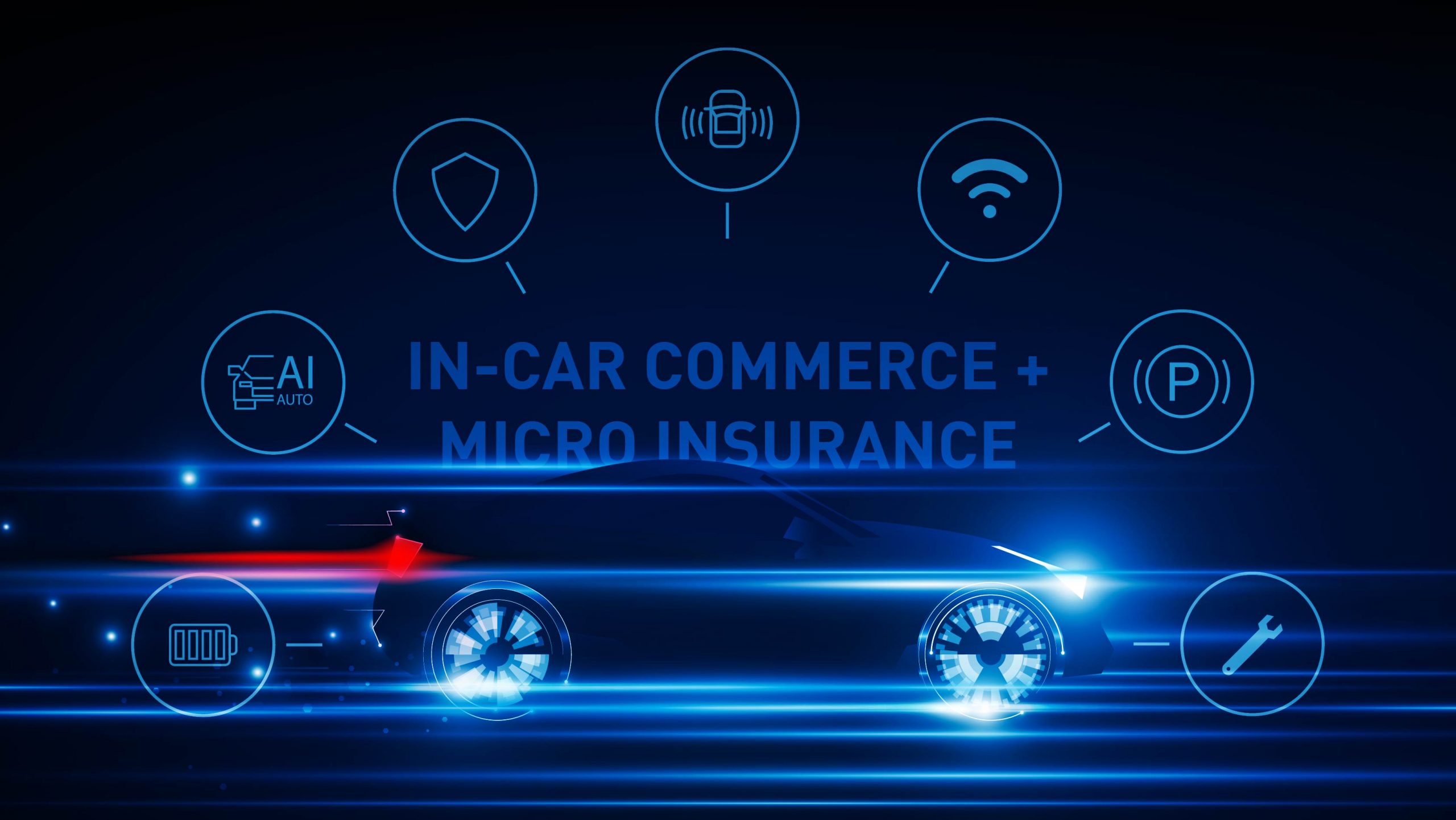
“In-car commerce” is the latest way to shop, with advances in on-board technology making this new commerce opportunity viable for the micro insurance industry to innovate within.

In this article, we take a look at how connected cars enable micro insurance and consider a few examples of how micro insurance incident protection can be used to provide a safety net and improve the driving experience.

Getting connected.

Connected-cars have been around since the mid 90’s, and have been evolving ever since. General Motors (GM) was the first manufacturer to develop an interactive in-car communications system. Their web-based OnStar technology enabled Cadillac drivers in the US and Canada to lock and unlock their doors from remote locations and connect to emergency operators, providing convenient security, safety, and roadside assistance features. Fast forward a decade and connected roadside assistance was still being showcased in the latest Hollywood blockbusters, with BMW’s connected ‘Assist’ featuring after a collision in Die Hard 4.

Nearly 30 years on from OnStar’s inception, huge leaps forward in technology have brought mobile networks, multi-touch screen dashboards and other things that consumers are used to on a tablet device to the fingertips of drivers.

In-car technology as an enabler for micro insurance.

Speaking of Hollywood – once fantastical gadgets reserved for James Bond’s vehicles are now very much a reality. Cars are increasingly being produced with exterior and interior cameras as standard, to aid drivers on-the-road and improve vehicle security. AI is also finding its way into the car – notably through assistants such as Apple’s Siri and Amazon’s Alexa – to assist the driver and passengers in real-time. Just don’t expect them to help you escape from a heavily guarded parking garage!

E-commerce is now in cars too – dubbed vehicle or in-car commerce in the automotive industry. Through a car’s dashboard system, consumers set up their payment information enabling them to make purchases for goods and services such as EV charging, fuel, and parking directly from their vehicle. This is of real benefit and an improvement in safety for drivers, who no longer need to use a smart phone at the wheel – or even leave their vehicle! – to make everyday purchases and links real-time location data to the services on offer.

Micro insurance is driven by data, analysis, and specified events. Connected cars are now collecting the types of data ideal for developing embedded micro insurance solutions, such as location, vehicle telemetry, image and video monitoring, and more! These data points can be used by claims handling AI to analyse and make informed decisions, providing drivers with real-time payments.

Representing a $230 billion commerce opportunity in the US alone, according to PYMNTS and P97 Networks, in-car commerce has the potential to become a major revenue channel for businesses – and this includes insurance.

What does this mean for retailers and micro insurance?

When purchases are made through a car’s dashboard, such as those mentioned earlier, embedded micro insurance can be used to enhance the value of the purchase – both for the retailer and customer. Micro insurance solutions provide an additional revenue stream for the retailer, while building customer trust and providing peace of mind that should the worst happen, enrolled customers are covered.

In the spirit of GM’s pioneering system, micro insurance can be applied to the automotive industry to offer convenient protections for vehicle security, driver safety, assistance with the cost of repairs, and protecting against on-the-road inconvenience. Let’s consider a few examples that could benefit from micro insurance.

Talk to us about MiIncome Mobility digital reinsurance and in-car commerce.

Smart Camera Parking Protection.

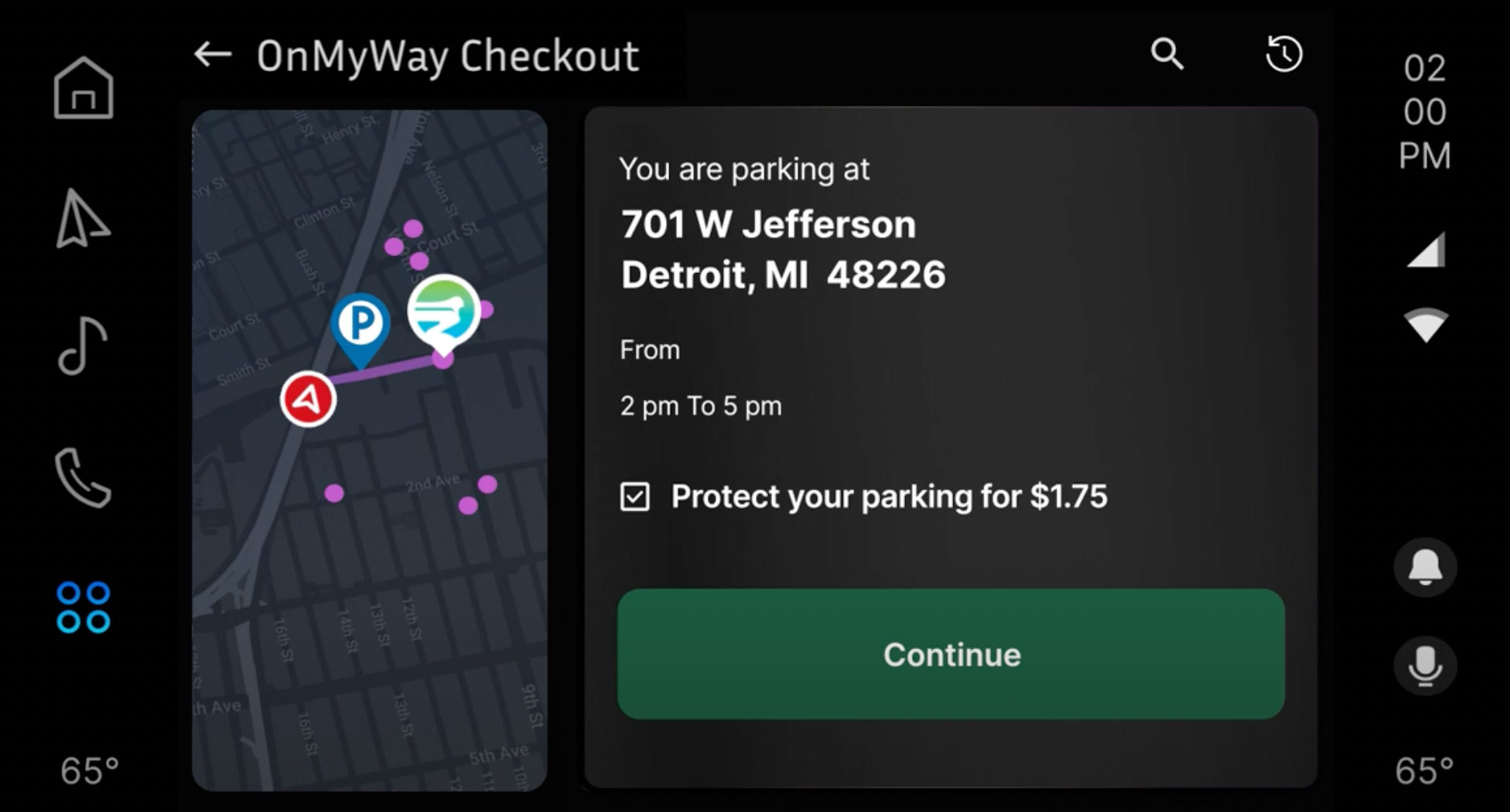
Anyone that drives a car has likely used a car park, purchasing a ticket for the duration of their stay. Drivers don’t know whether the car is completely safe, but it’s a risk that must be taken. Adding micro insurance to this transaction is one way to give drivers peace of mind over leaving their car – such as our recent partnership with Mavi.io’s OnMyWay Commerce platform. With the assistance of an integrated camera monitoring the vehicle – if a window is broken while the car is parked, the micro insurance product automatically provides an inconvenience payment for the driver to rectify the damages.

Mavi.io OnMyWay Commerce Checkout screenshot

Source: Park & Protect with OnMyWay dash demo | YouTube

Missed Restaurant Reservation Compensation

Since transactions are completed through the car’s dashboard navigation system, new and innovative applications for micro insurance can be considered. Innovation & Tech Today reports that booking restaurant reservations is a popular theoretical use case in consumer surveys. Micro insurance could be applied to this transaction, providing protection for if the driver becomes stuck in traffic – through the combination of on-board navigation, traffic monitoring, and time keeping, inconvenience payments can trigger to soften the disappointment of a missed reservation.

AI Monitored Vehicle Servicing and Repairs

Cars need to be serviced throughout their lifetimes to ensure optimum performance. This wear-and-tear servicing is not generally covered by car insurance, so falls to the driver to pay as required. Car manufacturers are creating AI damage detection tools to aid drivers and mechanics with repairs and servicing, boosting driver confidence in the vehicle and productivity for the repairers. Micro insurance can hook into this data collection process, providing payments when the AI detects a fault or service due, enabling drivers to immediately afford repairs rather than delaying.

Sharing Economy Car Insurance

Micro insurance is also perfectly suited to peer-to-peer car sharing – and according to Turo’s director, was originally created for that specific purpose. Drivers who share cars on an occasional basis have no need for a yearly insurance policy, so micro insurance fills this gap by providing timed trip insurance. This ad hoc insurance is typically purchased via an app, though with the advances in connected-car technology, these transactions could be completed through the vehicle’s dashboard.

This example of P2P car-share insurance could be taken one step further. Cars used by multiple drivers could require users to log in to their personal insurance profile on a dashboard app to purchase or verify their trip insurance before the car can be engaged. This would provide security to the car’s owner and reduce the likelihood of uninsured drivers on the road, making travel safer for everyone.

In time, as built-in telematics sensors become available, it is expected that unique risk profiles can be generated for individual drivers, saved to their user profiles. This will enable tailored micro insurance policies to be offered to the driver, rather than basing the policy on the vehicle.

The In-car Commerce Opportunity

With in-car commerce representing such a large opportunity for revenue, it’s only natural for the insurance industry to look for ways to integrate and support new customers. This opportunity is not just revenue driven – there is also the chance for new micro insurance innovation. Connected in-car technology is collecting valuable data which can be used to develop inventive solutions to problems that inconvenience drivers every day. As in-car technology becomes more advanced and abundant, new partnerships with like-minded tech companies are a practical approach to enhancing drivers’ vehicle-based transactions.

Micro insurance is parametric in nature – triggered by specific events – and is purchased at a point of sales where it is often embedded with a relevant adjacent product giving access to insurance when needed rather than as a blanket coverage. Coupled with its convenience and affordability, this makes in-car commerce a prime untapped target for the micro insurance industry.

Contact us to see how MIC Global can help your business benefit its customers and employees with an embedded micro insurance solution, or simply send us your email address above to get started.

Let’s Grow Together

Explore Our Demo

In The Press

Navigating Daily Disruptions: How MiIncident Supports Customers When Life Happens

09.20.2023
Micro Insurance MiIncident
blog miincident

Update March 2024: Our MiIncident triggers are now part of MiIncome.

Life is a journey full of surprises, adventures, and unforeseen challenges. Every day, we encounter a myriad of risks. Many of these risks are minor disruptions that hinder our day, creating problems to solve that we hadn’t accounted for, though some can cause major setbacks. It could be a delayed flight, a damaged mobile phone, or in worse cases a natural disaster – the reality is that disruptions are an inherent and unavoidable part of life.

Understanding the daily risks we face enables us to plan for accidents and eventualities beyond our control, helping to mitigate the financial impact and inconvenience caused by unexpected incidents. However, this task often proves to be more challenging than anticipated, particularly when it comes to emerging risks that lack appropriate coverage options – leaving us to make reparations when incidents occur.

How can your company help customers with everyday risks?

Introducing MiIncident

We have developed the MiIncident digital reinsurance solution, a suite of event-based triggers that protect people’s property and possessions, and against daily disruptions. The suite includes Travel Inconvenience, Gadget, Sensor, Porch, and Mobility, with each designed to provide lump-sum reimbursements to individuals who are affected by incidents beyond their control.

MiIncident differentiates your company or service by enabling you to offer timely opt-in coverages to customers. For example, while purchasing a smart doorbell device, a MiIncident program can be offered to replace packages in the event of porch piracy (theft). Whatever your line of business and your customers require, MiIncident can be customized to cater to your specific demographic, desired coverages, or program size. We collaborate with you to ensure that MiIncident is efficiently delivered to your business and the customers within your market.

Your company + MiIncident

MiIncident is an embedded micro insurance product that is implemented into your company’s existing digital platform or service – typically embedded into warranty products, finance products, and guarantees. With a MiIncident program as part of your company’s digital offering, customers are encouraged to opt-in to applicable coverages during the purchase journey, when it’s most relevant for them to consider. MiIncident can also be included as an integral part of a product or service itself, for example within an IoT device service warranty.

The possibilities for incident protection are endless and MiIncident enables this popular product category – delivering useful coverages for everyday risks. When an enrolled customer is affected by a covered incident, they can claim benefits directly from your company’s app or website. Through an integrated API connection, our MIC machine receives customer claim requests for efficient automated handling. Our AI-powered claims process evaluates and investigates the claim details, ultimately making a quick settlement decision* before sending funds to our local insurance partner. This effective process ensures that you can help your customers with funds in their bank account within a matter of hours – allowing them to focus on solving their problem without worrying about the financial implications.

Including MiIncident in your company’s service or product demonstrates to your customers your long-term commitment to their purchase decision. Whether it’s a shattered phone screen, catastrophic weather event, or lost luggage (to name a few!), MiIncident coverages reassure customers that when faced with inconvenience, your company will be there to provide a helping hand – boosting customer satisfaction and brand trust.

MiIncident Triggers

The MiIncident suite consists of six triggers, which are used to create your company’s incident protection program. Each trigger has been developed to cover specific circumstances that impact individual’s lives. These triggers are designed to complement each other, for example a Gadget program could be combined with elements of Travel Inconvenience to offer additional coverage in the event of laptop damage as a direct result of rough baggage handling.

Travel Inconvenience supports travellers in the event of disruption beyond their control that incurs unaccounted for financial outgoing. This could be a delayed flight where an individual needs to buy food while waiting, lost and delayed luggage after a journey that causes a missed connection. In the event of disruption and incurred cost, customers are reimbursed with inconvenience payments to put toward dealing with the situation. Read about Travel Inconvenience.

Gadget covers accidental damage to tech product components, unexpected mechanical breakdown, extended warranty, and theft. We protect a wide range of tech products including mobile phones, point of sale (POS) devices, IoT devices, cameras, drones, sports equipment – and we’re always open to discussing more tech categories! The Gadget trigger provides payments that can be put towards repair or replacement of covered products so that people can get back to using their gadgets as required. Read about Gadget.

Sensor is a warranty coverage linked to IoT sensor devices. Sensor is embedded in the service warranty of specialised devices for monitoring water leakage unrelated to weather events, providing reimbursement for water damage and loss for protected buildings. With the influx of flow and leak detecting IoT sensors for various applications – such as gas flow, electrical current, and pressure sensors – the Sensor trigger can be adapted to meet the requirements of your market.

Porch Package Piracy is a service guarantee that can be embedded into IoT devices such as security cameras and smart doorbells. If a package is left within sight of a covered device and consequently stolen, subscribed customers can claim for reimbursement to pay for replacing the package. With people’s shopping habits increasingly moving online, package deliveries on porches have quickly become a common sight. In response, the Porch Package Piracy trigger is designed to mitigate the risks of packages left in insecure locations. Read about Porch Package Piracy.

Mobility is there for drivers and vehicle companies when they are faced with disruption. Whether a damaged vehicle needs quick repair, a vehicle is targeted and parts stolen, or the vehicle itself is stolen – the Mobility trigger enables quick payments to get drivers back on the road.

Tell me more about MiIncident

To learn more about MiIncident, visit our product page and get in touch with us below or via our contact form to discuss how we can help enhance your business’ customer support benefits.

* 80% of claims turned around within 48 hours, May–Dec 2023.

Let’s Grow Together

Explore Our Demo

In The Press

How to Build a Micro Insurance Company: The Four Pillars for Success

08.23.2023
Insurtech Micro Insurance
blog fourpillars

In a world brimming with uncertainties, the need for accessible and adaptable insurance solutions has never been clearer. This is where micro insurance steps in, offering a safety net to those who often fall through the gaps of traditional coverage.

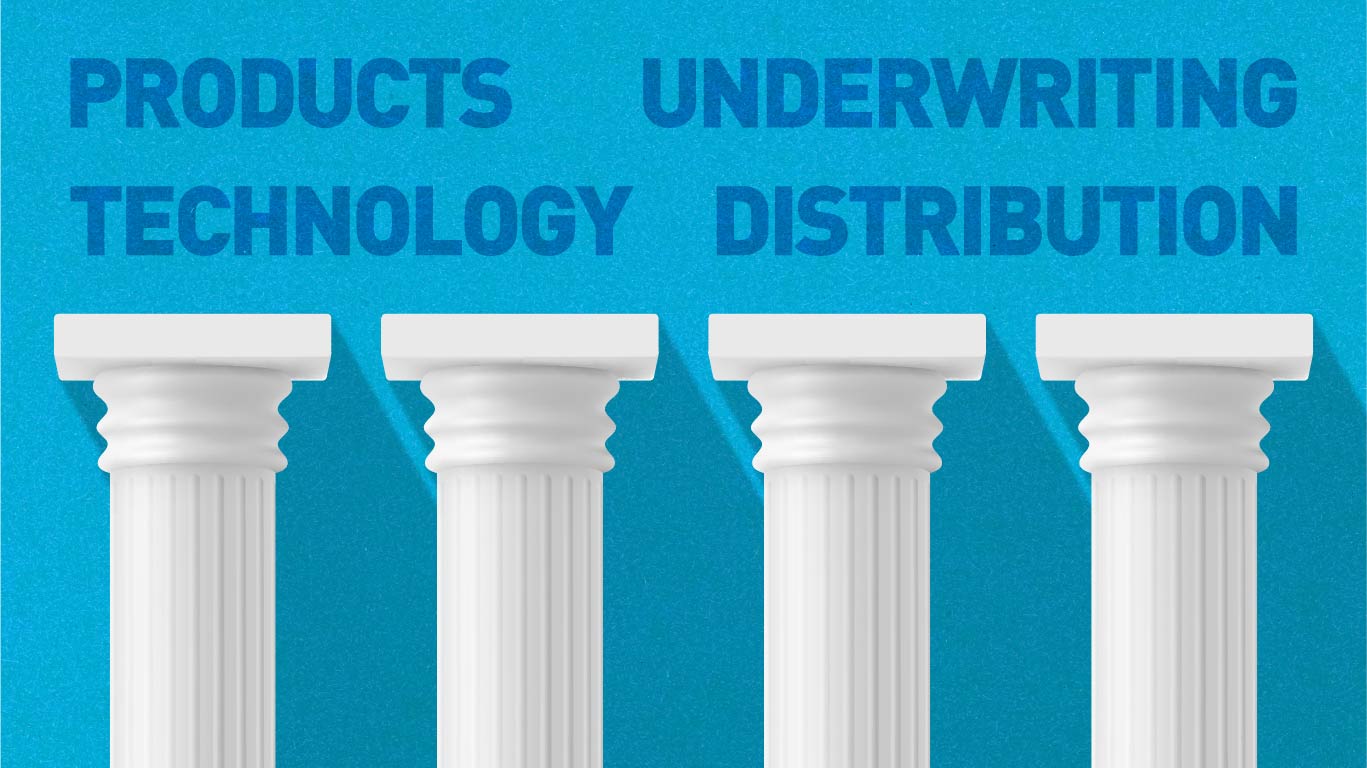
This is enabled by micro insurance companies – such as us! – who are built with four fundamental pillars: products, underwriting, technology, and distribution. These elements form the foundations upon which a micro insurance venture stands, determining its ability to reach individuals and provide them with timely protections. Each pillar is crucial in order to serve embedded micro insurance products at scale, on a global level, and – most importantly – profitably.

Here, we examine the pillars needed for a successful micro insurance company, how we utilise each within our own business, and what they mean for our development process, partners, and end-customers:

Simple and Relevant Insurance Products

Micro insurance products are the first essential element – nobody can be insured without a product to offer them! Where traditional insurance products are comprehensive and cover significant aspects such as life, health, home, and car; micro insurance products are simply worded and focus on the small stuff – everyday disruptions that people face such as accidental damage, minor medical expenses, and income gaps. Developing micro insurance products is all about creating solutions to meet the unique needs of individuals with customized product offerings that address specific risks.

These products aren’t concerned with the specific losses or damages that occur – instead, fixed pay-outs are made once defined parameters are met. This approach allows micro insurance to operate in spaces where traditional insurance may provide limited coverages. Early success is being seen within the sharing and gig economies.

Products Designed for Everyday Risks

We have developed a simple and relevant digital reinsurance solution – MiIncome – designed to fill the world’s insurance protection gaps that traditional insurance is not suited to cover. MiIncome is split into distinct triggers, each covering different aspects of people’s lives. When activated, the trigger events allow insured individuals to make a claim. We work with our insurance and platform partners to tailor these triggers to their requirements and create a digital reinsurance solution that fits them perfectly. A partner’s micro insurance product is embedded into their platform or service and offered to their customers during the sales journey.

Crucially, these products are repeatable. This means that once we have developed a particular product in a market, we can roll it out over and over, tweaking as required for each partner. Rapid development and deployment enable platforms to take their insurance product from concept to customer in weeks.

Putting Money in People’s Pockets

Our MiIncome digital reinsurance solution consists of short-term loss of income triggers, covering people’s personal income when threatened by specific circumstances. Let’s look at a few examples.

  • MiIncome Involuntary Loss of Employment offers two or three monthly payments to help cover the loss of income experienced by workers that receive involuntary unemployment while they find a new job.
  • MiIncome Accident & Health provides coverage for individuals who suffer a personal accident and are unable to work or face unexpected medical expenses such as Emergency Room visits or hospital stays, meaning people can look after their health without the worry of how to pay for it.
  • MiIncome Resilience protects individuals from events that disrupt income, such as extreme weather, public transit outages, and family matters.

We also offers triggers for personal property, possessions, and disruptive events that impact individuals in their daily lives. Protections are designed as warranties for tech devices such as mobile phones, IoT sensors, and smart home devices, and inconvenience payments when traveling such as a delayed flight or lost suitcase.

Our MiIdentity solution protects people’s physical and digital lives. Our robust MiIdentity platform, coupled with MiIncome Digital Identity reinsurance, provides protection in cases of identity theft and resultant monetary fraud, reimbursing people for lost funds when targeted by malicious actors.

Each of our triggers give insured individuals peace of mind that should they face the misfortunes that they are covered. Our solutions support our partners in providing timely inconvenience payments to their customers, quickly putting money in their pockets to help bounce back comfortably.

Innovative Underwriting

The next step is to underwrite the products in order to insure people. Simply put, underwriting is the process by which insurance companies assess risks and determine the terms, conditions, and pricing of insurance policies.

For consumer insurance policies, this involves analyzing factors like an applicant’s health, age, occupation, and lifestyle to make informed decisions about coverage eligibility and premium rates. Reinsurance – the transfer of a portion of a primary insurer’s risks to other insurers – involves a different type of risk evaluation. Reinsurers (that’s us!) assess the risks that primary insurers take on, with reinsurers focusing on assessing and modelling portfolios before deciding to offer reinsurance. This process helps spread and manage risk, enhancing the stability of the insurance market.

There are many underwriting companies out there that can assist, however, legacy systems, processes, and convoluted distribution chains have lumbered much of the industry with  high costs and premiums for end-customers – which isn’t ideal for micro premiums. Fortunately, there is another way!

Data-driven Underwriting, Backed by Lloyd’s

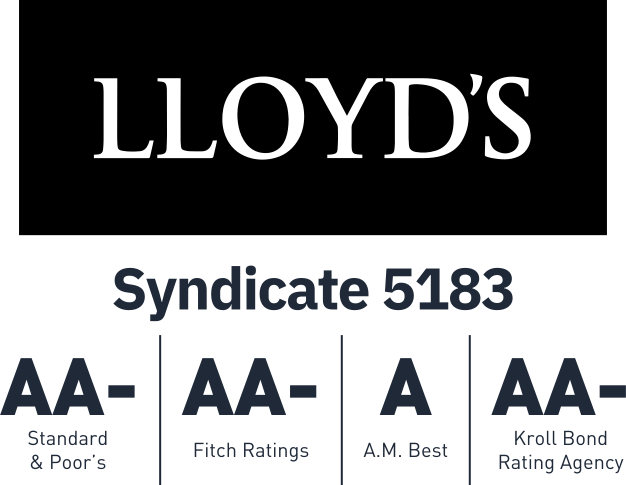
To keep our premiums low and be able to sell our products globally, we set our sights on underwriting in-house. First, we built an underwriting team consisting of underwriters, actuaries, and operations and compliance experts. Next, we undertook the monumental task of opening a Syndicate with Lloyd’s of London, MIC Global Syndicate 5183, which we achieved in June 2022 – after an immense amount of hard work and dedication from all involved! As of January 1st, 2025, we continue to leverage Lloyd’s of London’s scale and resources as a Coverholder for Greenlight Re’s Syndicate 3456.

We have a clear and focused product development process where we simultaneously carry out data analysis, risk assessment, decision making, wording development, and premium pricing. This ensures our digital insurance products are designed efficiently, reducing cost and increasing speed to market.

With our underwriting operations in-house, we can better understand our active accounts. As data begins to flow from partners – using APIs – our team analyses the information and creates detailed reports. This enables us to discuss pricing strategy and make informed recommendations to our partners and local insurance partners quickly to drive growth and profitability, while feeding more data into our own pricing models to facilitate future projects.

Our products are underwritten by certain underwriters at Lloyd’s and in-house through MIC Re, so we are able to offer microinsurance to global partners, accommodating projects of all sizes and scope.

Lloyd's logo with 'Syndicate 5183' and financial ratings
MIC Re and Financial Services Commission Anguilla logos

Advanced Technology Built for Scale and Speed

Selling insurance to customers inevitably leads to claims, which need to be processed and settled. It’s possible to achieve this through spreadsheets and file systems, which is fine when there’s only a few policies to handle… but this method soon becomes complicated and difficult to maintain where there are millions of insureds.

Technology for the Digital Marketplace

We invested in technology early on, creating our own tech company – MiCology. This India- and UK-based team specialises in low-code technologies and the development of powerful AI and machine learning algorithms.

Our highly relevant, affordable, underwritten embedded micro insurance products can easily be added into business’ existing digital processes through our advanced technologies. This accelerates the delivery of our digital reinsurance products when and where customers need them, allowing them to gain access to cover that is not readily available through traditional insurance methods.

With MiConnect, partner systems are operational faster than ever

Our low-code tech platform – MiConnect – enables us to configure partner systems rapidly, using pre-built components that can handle the entire insurance process, from policy management, to claims handling, to complaints. Importantly, these systems are built on cloud platforms, giving flexible scalability as insurance programs grow and more customers sign up.

Speed also comes to claims handling: with our machine learning powered digital claims process, customers have money in their pockets faster.

Configured systems are integrated with our partners’ websites and services via API, so when a claim is raised, we can start handling it swiftly*. The process is automated, with our AI machine calling in real world help when necessary. And the more claims handled, the smarter our machine becomes. Local insurers and platform companies are paid quickly once a settlement is reached, enabling them to help their customers fast.

Our claims process is monitored with real-time dashboards so partners can keep track of all the data relevant to their business – embedded microinsurance in action!

Global Distribution through Local Insurance Partnerships

Products, underwriting, and technology – it’s nearly time to start insuring people! Now these carefully crafted coverages need to get into people’s hands so that they can begin to reap the benefits. This is where distribution partners come in.

Our Lloyd’s of London Syndicate 5183 allows us to utilise Lloyd’s international licenses to write business globally. We have been building a worldwide distribution network of local insurance partners, to which we provide our digital reinsurance solutions. These local insurers are experts in their local markets with all the necessary licenses in place to insure individuals.

Our insurance partners issue insurance policies, taking on the local responsibilities of policy issuance and management, claims payment, and compliance with local regulations. Working with insurance partners enables us to offer coverage in a wider range of markets than would otherwise be possible.

Global Distribution for Partners and Brokers

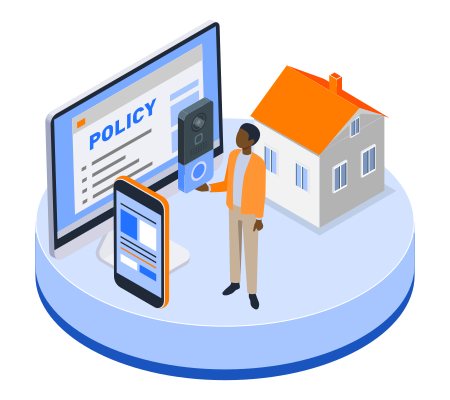
Embedded micro insurance Distribution platform illustration

Digital Insurance Product & Technology Enablement

for Distribution Partners, Banks, Financial Services, Telecom, Travel

Embedded micro insurance underwriting capacity illustration

Underwriting Capacity

for Insurtechs, Insurance Companies, MGAs

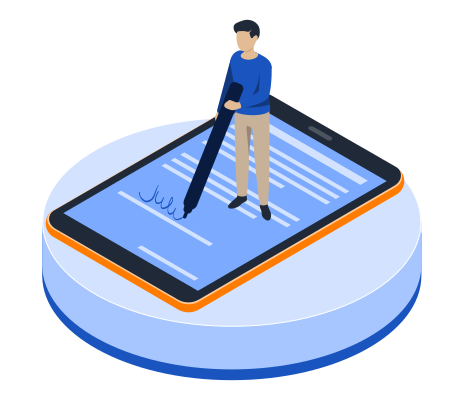
Enterprise illustration

Insurance as a Service

for Enterprise, Sharing/Gig Economy, Mobility, Payment Gateways, eCommerce

Full Stack Digital Embedded Micro Insurance

The elements discussed above are all required to be classed as a full stack offering – this capability enables micro insurance companies to serve embedded micro insurance products at scale and on a global level. We have carefully combined these pillars to build the world-first full stack digital micro insurance company we are today, and in doing so we uniquely differentiate ourselves from similar companies worldwide.

  • A robust product portfolio tailored to the unique needs of diverse communities lays the foundation for trust and relevance.
  • The meticulous underwriting process, brought in-house through our Lloyd’s Syndicate, ensures both long-term sustainability and optimum premiums for end-customers.
  • Cutting-edge technology transforms the insurance and claims process, streamlining operations and improving user experiences.
  • A global distribution network ensures that these valuable services reach the farthest corners, leaving no one beyond the reach of security.

Contact us to find out how these essential elements can be used to create a micro insurance product perfectly suited to your target market, adding value to your business, and increasing customer retention and satisfaction, or simply send us your email address to get started.

* 80% of claims turned around within 48 hours, May–Dec 2023.

Let’s Grow Together

Explore Our Demo

In The Press

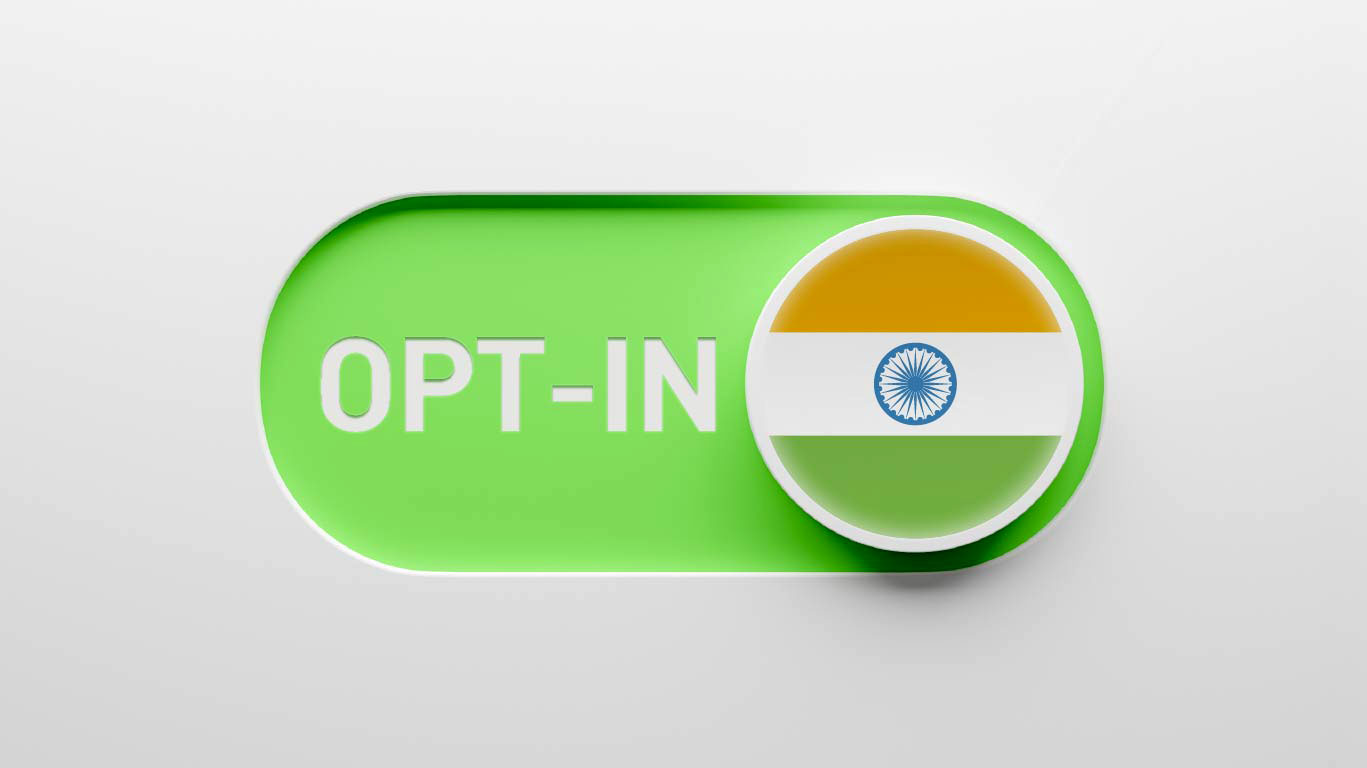
OPT-INdia: Using Embedded Micro Insurance as a Catalyst to Fill India’s Insurance Protection Gap

08.16.2023
Insurance Industry Insurtech Micro Insurance
blog opt india

India, with its vast population and growing economy, is faced with a significant insurance protection gap – one of the largest in the world. This gap has major social and economic impacts and is prevalent across various segments of the population, posing substantial risks for individuals, families, and businesses.

Why has a protection gap opened? How large is India’s insurance protection gap? How can embedded micro insurance be used to begin filling the space left by traditional insurance companies? Here, we discuss India’s insurance crisis, what strategies can be implemented to combat the gap, and how MIC Global is busy developing relevant products for the Indian market.

Why is there an insurance protection gap in India?

Having insurance is important, there’s no two ways about it. A thriving insurance industry helps mitigate the risks associated with ill-health, loss of income, catastrophes, and theft, to name a few. So, if insurance is such a commodity, why isn’t the Indian market signing up?

From a customer perspective, there are common myths surrounding the purchase of insurance which may play a part, such as unaffordable premiums and a distrust in the insurance industry to honor submitted claims1; while financial illiteracy (a lack of awareness of insurance products and understanding of complex clauses – this is also a global issue), knowing where to buy, and relevancy seem more likely culprits2. Existing insurance products often fail to meet the specific needs of the population, compounding the already low uptake.

Moreover, the underdeveloped insurance infrastructure in the country is another critical factor contributing to the protection gap. Insurance distribution outside of major cities is poor, with general insurers and brokers largely operating inside urban centers. A presence in smaller towns and villages is perceived as unviable due to low profitability2. This leaves limited access for a substantial portion of the country that are without adequate coverage, despite being highly vulnerable to risks.

Many of the issues above can be remedied with suitable insurance products, timely education around available insurance, and improved distribution channels that do not require a physical insurer presence. We’ll get into that later.

Let’s talk numbers.

What exactly is an insurance protection gap?

A country’s insurance protection gap is defined by the disparity between the insurance coverage needed and the actual amount of coverage the population has in place. For example, if a country’s optimal insurance coverage is $2 billion, and the actual coverage in place is $1 billion, the protection gap would be 50%. This gap is flexible and can be affected by the country’s economic outlook and population, and risks such as climate change, cyber security, pandemics, and technological and behavioural changes3.

India’s insurance protection gap.

Speaking at 2021’s National Insurance Academy annual summit, Naveen Tahilyani (CEO, Tata AIA Life Insurance Co) said India’s non-life protection gap ranges from 83% to 92%, with life experiencing a lower percentage4. However, the natural catastrophe protection gap was estimated to be higher, peaking at 95% according to Swiss Re Institute5. With the increase in frequency and intensity of natural disasters and emergence of new risks – such as cyber – to people and industry, G Srinivasan (director, National Insurance Academy) reinforced the urgency to plug the rising uninsured economic losses and loss of lives6.

This represents a huge opportunity for insurers. Where traditional insurance is falling short, this leaves the market wide open for a new approach to insuring India’s under- and uninsured population. To fill this chasmic protection gap, SN Rajeswari (member distribution, IRDAI) suggested insurance companies must increase reach and the potential for uptake by adopting new strategies through leveraging digital technology, data, and micro insurance4.

How can embedded micro insurance help reduce India’s insurance protection gap?

Embedded micro insurance directly counters the issues discussed earlier surrounding distribution, accessibility, education, and relevancy.

In short, traditional consumer insurance policies are generally designed for large coverages, such as life, home, and car. Customers sign up to products directly with an insurance company either online or in-person (historically in India, in-person has been the only way in rural areas), and claims are made by contacting the insurer. As we learned earlier, this strategy is clearly not working in India.

Conversely, embedded micro insurance is intended to offer protections for smaller everyday events. Embedded micro insurance products are digitally distributed via platforms that customers are already engaging with – no need to contact an insurance agency. These insurances are relevant to the product or service they are purchasing, at a time when they are primed to learn about the benefits and consider opting in – such as screen protection for a mobile phone, or as part of a service’s additional benefits, such as income protection for credit card users. Claims are raised through the platform they signed up with, so customers do not have to deal with an insurance company at all.

From a customer perspective, opt-in insurance is convenient, timely, and less imposing than signing up for traditional insurance.

Additionally, access to affordable and relevant insurance products is highly desirable. With small premiums, customers have the option to carry many different insurances that are suited to their needs at the time, rather than traditional blanket coverages. Low premiums also fit the limited budgets of low-income individuals, which in turn encourages greater adoption of insurance products among this segment of the population.

In time, as more platform companies offer embedded micro insurance programs, India’s insurance protection gap will gradually reduce as customers opt-in to products.

Financial inclusion through digitisation and collaboration.

The Indian government is transforming the country into a digitally empowered society with its Digital India initiative. Part of this is building digital infrastructure – known as the India Stack – with one goal being to aid financial inclusion in the country. At the 2023 India Stack Developer Conference, Smt. Debjani Ghosh (President, NASSCOM) stated that financial inclusion through digital means had already reached 80%7. With more of the population managing their finances online, the opportunity for digital insurance penetration becomes more viable.

With greater digital financial inclusion, the government is proactively working with insurtech to develop simplified and easy to understand insurance products to protect the Indian population and counter India’s protection gap.

What is MIC Global doing to help in India?

We are working with local insurance stakeholders to bring innovative embedded micro insurance products to the Indian market. With our digital reinsurance solutions, we have created a repeatable blueprint from which further products can be rapidly rolled out.

This speed to market is enabled by our full-stack capability. By controlling the four key areas of product design, underwriting, our own insurance technology platform, and managing our distribution network, we can rapidly write and deploy products to new partners in weeks. This empowers our partners to quickly identify gaps in the market and deliver crucial coverages to their under- and uninsured customers.

MiIncome, our digital reinsurance solution contains triggers that already have the bulk of development completed, so when partnering with a new client, we simply customise the desired product to their needs, enabling us to meet the specific needs of different communities. If the triggers don’t fit a partner’s needs, we work together to design a suitable solution. This flexibility ensures highly relevant coverages that align with the unique risks of our partners’ customers.

Examples of this include:

  • Our MiIdentity platform, developed to monitor consumer data against the growing threat of data breaches that results in compromised personal information being used for credit fraud, providing reimbursement when a customer is impacted financially. This is offered through a national insurance institution specialising in general insurance.
  • A MiIncome product, designed to offer income protection as a result of involuntary unemployment. This is offered through a private insurer who is rolling out to relevant digital platforms through a company that creates service-oriented technology solutions.
  • An embedded warranty product, in the event of mobile phone screen and internal component damage, enabling repair or replacement of the device. This product is being expanded to protect consumer purchases across other segments such as portable gadgets, fashion, and accessories.

Challenge accepted.

India’s insurance protection gap is a challenging issue that requires concerted efforts from various stakeholders, including the government, insurers, and insurtechs. Alongside government’s initiatives to improving access to digital finance and insurance, embedded micro insurance is positioned to be a promising solution to the protection gap left by traditional insurance companies. By offering affordable, tailored, and accessible insurance products, platforms and services armed with embedded micro insurance solutions – such as those developed here, at MIC Global – can play a vital role in providing a safety net for the underserved sections of Indian society. Slowly but surely, the insurance protection gap will begin to close.

Contact us or simply send us your email address below to see how we can collaborate with your business to benefit its customers and employees with an embedded micro insurance solution, or simply send us your email address to get started.

Sources

  1. Nova Benefits, Why Indians DON’T Buy Health Insurance
  2. Mint, Four reasons why Indians buy such little general insurance, 16 April, 2016
  3. Insurtech Insights, The Insurance Protection Gap: What is it and how does it affect the insurance industry and our quality of life?
  4. The Economic Times, Insurance penetration in India requires combined efforts of all stakeholders, 15 October 2021
  5. Swiss Re Institute, India’s insurance market: poised for rapid growth, January 2023
  6. Financial Express, Need to close insurance protection gap in country: Irdai member, 15 October 2021
  7. PIB Delhi, The First India Stack Developer Conference held on 25 January 2023, 25 January 2023

Let’s Grow Together

Explore Our Demo

In The Press

Hope for the Best, Plan for the Worst: Developing Embedded Micro Insurance Products for Life’s Unexpected Events

08.09.2023
Micro Insurance
blog header

Life is great when it’s going smoothly. But as is the way with life, obstacles can appear that throw us off course – and we don’t always see them coming.

This uncertainty is the reason why insurance and companies such as MIC Global exist. It’s not pleasant to have to think about what can go wrong – we all want the best in life and to get by unimpeded – but by considering what worst cases can happen to us and investing in appropriate protections, we can be in a better position should we find ourselves in such circumstances.

So, how do these protection products come about? At MIC Global, we keep track of trends and emerging risks in order to innovate with new products and partners – making relevant insurances available to people so that they can quickly recover when faced with adversity.

In today’s article we explore three news stories from this year and what products we have developed that can support individuals who find themselves in similar situations:

Note: The embedded micro insurance products discussed below are not offered to end-customers directly by MIC Global. We provide our digital reinsurance products to local insurance partners, which support our platform and service partners’ own insurance offerings.

Involuntary Unemployment: Safeguarding Livelihoods Amidst Uncertainty

According to Forbes’ 2023 Layoff Tracker, the US has already seen around 230,000 job cuts this year – and that’s just the big, noteworthy companies. The number is likely higher given the huge number of small and medium businesses. Fifteen-year high interest rates, above average inflation, and trading in a post-pandemic economy has forced many companies to make difficult decisions to stay afloat.

With much of the workforce unable to cover a $500 emergency, an unexpected layoff can put individuals and families in an extremely vulnerable position, potentially unable to pay their essential bills and expenses. This is worrying at the best of times, but with rising household bills, mortgages, and rental fees, people are more reliant than ever on not losing their jobs.

How is MIC protecting against involuntary unemployment?

Our MiIncome product suite has been designed to protect people’s personal incomes in the face of adversity. The ‘Layoff’ trigger has been specifically written to support individuals who become laid off through no fault of their own.

When laid off, an insured individual can raise a claim to receive cash payments straight to their bank account, which helps cover their essential costs of living while they find themselves a new job or income stream.

A recent example of this is our partnership with Grid, a leading US neo-bank. Grid offer their Income Protection program to their customers, which includes embedded micro insurance supplied by MIC Global (as digital reinsurance via The Plateau Group). When receiving involuntary unemployment, customers can inform Grid of their new situation and receive $2,000 payments for up to two months, so that they can focus on finding a new job with less financial burden.

Job loss is a very real threat to people’s incomes and livelihoods and depending on individual financial wellbeing, it can be crippling. Insured customers with MiIncome coverage can plan ahead knowing that they will have cash in their pockets should the worst happen to their job.

Smart Phone Damage: When Life Happens to Devices

In 2023, according to Statista, smart phone adoption globally has reached a staggering 6.92 billion users, or 85.95% of the world’s population, as reported by Bankcell. This inevitably leads countless damaged smart phones every year. A survey of 3,286 Americans by AT&T, as reported by Forbes, revealed that three quarters of adults aged 19–44 have broken a smart phone at some point – the top five reasons could happen to anybody!

Smart phones have become so engrained in life that for some, their livelihoods rely on having an operational device – for example ride-share drivers who work via apps to pick up jobs and communicate with customers. Losing use of a smart phone can take a real toll on people’s ability to earn if they are unable to replace quickly. For others, a shattered screen may not lead to financial hardship, but it is still an inconvenience that hits their bank account that they could do without.

How is MIC protecting against smart phone damage?

We understand how frustrating a broken smart phone can be – we’ve all been there! We created our MiIncome ‘Gadget’ trigger to handle life’s daily disruptions, including smart phone damage. This trigger is purpose built to look after individual’s smart phones – as well as a whole host of other tech products – from component damage, mechanical breakdown, and theft.

We work with our partners to develop warranty products that can be offered to their customers as part of the purchase of their smart phone. In April 2023, we launched our partnership with Turkish cell phone renewal center Garantili Teknologi and Swiss insurtech Virtual i Technologies, in support of their innovative embedded warranty product. In the event of smart phone damage, insured Garantili customers can diagnose and verify damage via an AI-powered app before making a claim. This speeds up the claim process and puts claim payments in customer pockets fast so that they can choose to repair their device via Garantili’s refurbishment center or replace their device.

Smart phone users insured through a platform offering a warranty solution backed by MiIncident can receive quick payments* to mitigate financial burden, so they can get their devices repaired and back in their hands with low disruption, meaning that those who are reliant on their smart phone avoid the worst-case scenario of being without their device for too long. Furthermore, it was predicted that 5.3 billion mobile phones became waste in 2022 alone, so having coverage to repair devices helps people do their part for the environment by using devices for longer and reducing e-waste.

Identity Theft: Guarding Digital Identities

A data breach in October 2022 was alleged to have exposed the personal information of Australian Sarah Luke to the Dark Web. Her information was picked up by hackers and became involved in a credential stuffing cyber-attack launched at Paypal in December 2022, as one of around 35,000 accounts used. Hackers gained access to her Paypal account and committed hundreds of fraudulent transactions before she was able to regain control. She has since been ordered by US courts to pay US$1.2M to Adidas and the National Basketball Association (NBA) due to sale of counterfeit goods in her name. Ms Luke is now trying to clear her name through the relevant authorities.

Data breaches and stolen personal information are an ever-present threat for companies and individuals, becoming increasingly prevalent as companies go digital. Thankfully for most, stories of the severity described above are not common – but that’s not to say that personal information leaked to the Dark Web isn’t a serious concern.

How is MIC protecting against identity theft?

We have developed the MiIncome ‘Digital Identity’ trigger, which is coupled with our MiIdentity platform. Together, individuals are assisted with identity tracking, restoration, and money loss.

Identity restoration claims are activated when two events occur: an individual’s identity is stolen and is subsequently used in fraudulent activity. We support people to reclaim their identities with inconvenience payments that help to replace documentation, bank cards, and personal IDs, and to restore their credit history. Furthermore, in the event of monetary loss from a financial account caught up in the identity restoration claim, we offer lump sum payments to help people recover from lost funds.

Considering the example above, if enrolled with our MiIdentity coverage Ms Luke and the other affected account holders would have been made aware of these possibilities and alerted when our monitoring service discovered their data listed on the Dark Web. Knowing your information is on the Dark Web and potentially for sale is just the first step in protecting your identity. Our MiIdentity service enables individuals to take measures to protect their accounts, to be aware of their compromised accounts, and receive financial support to regain control where necessary. This can help to avoid personal accounts being used by malicious actors for fraudulent activities which, as seen here, could spiral into international legal proceedings – a prime example of ‘what’s the worst that could happen?’

Contact us to see how an embedded micro insurance solution from MIC Global can help your business protect its customers from their own worst-case scenario, or simply send us your email address to get started.

* 80% of claims turned around within 48 hours, May–Dec 2023.

Let’s Grow Together

Explore Our Demo

In The Press

From Songs to Dollars: How iPod Helps to Define Micro Insurance

07.26.2023
Insurance Industry Micro Insurance
blog pocket

There are many things that the late Steve Jobs will be remembered for. For us, one of his outstanding qualities was his innate ability to explain and market a product in a way that resonated with consumers. In this article, we reveal how his genius description of the original iPod shaped the way we think about our own micro insurance products.

Sell benefits, not features.

In 2001, at a small press event at Apple’s former Infinite Loop headquarters, Jobs revealed the first-generation iPod. Holding the gadget for the audience to see, he coolly explained “This amazing little device holds 1,000 songs and it goes right in my pocket”, casually slipping it back into his own pocket.

The iPod revolutionized the music industry overnight – becoming the must-have tech device of the early 2000’s – with Jobs’ simple explanation becoming the basis of its marketing campaign: 1,000 songs in your pocket.

Instantly, people knew what the iPod was about. Now, Apple could have marketed the iPod for what it was: The world’s first portable digital media player, 5GB hard drive, superfast Firewire connection, rechargeable lithium polymer battery… but to the average consumer that’s just tech jargon. Companies have a matter of seconds to make a first impression, so messaging is crucial – a more detailed explanation can come once a customer is engaged. When getting the attention of a potential customer, one way to make a solid first impression is to tell them how a product will benefit them – how it will make their life better.

For the iPod, those five words said it all. “1,000 songs” – that was comfortably more than the typical persons’ entire music library. “In your pocket” – it was small, portable, and easily accessible. People understood and proved it in their millions – by the time Apple retired the iPod line in 2022, it was estimated that they had sold 450 million devices.

Drawing inspiration.

Much like how the iPod transformed the music industry and how people experienced music on-the-go, micro insurance is revolutionizing the insurance industry and how people think about and access insurance.

Traditionally, personal insurance policies are applied for via a comprehensive in-person or online sign-up process, with successful applicants receiving documentation containing their policy certificate and details of how to make a claim. Likewise, the claims process itself can be documentation heavy, and slow to validate and pay out. Often these policies provide coverages measured in thousands – such as for health, life, home, and vehicle – with premiums paid monthly or annually. In some ways, conventional consumer insurance can be like the portable CD players of old – cumbersome, awkward to navigate, not particularly convenient, and people carried just a few discs at a time.

Which is where micro insurance comes in, offering an alternative to regular insurance. We could, and often do, describe our brand of digital reinsurance for what it is: digital embedded micro insurance products, underwritten by certain underwriters at Lloyd’s and in-house through MIC Re, partner driven global distribution, powerful API enabled straight through processing for claims and policy management. Within the insurance industry these terms are well understood, much like the iPod’s description above within the tech industry. But as an explanation of what we do for the everyday person, it’s not necessarily as easy to grasp.

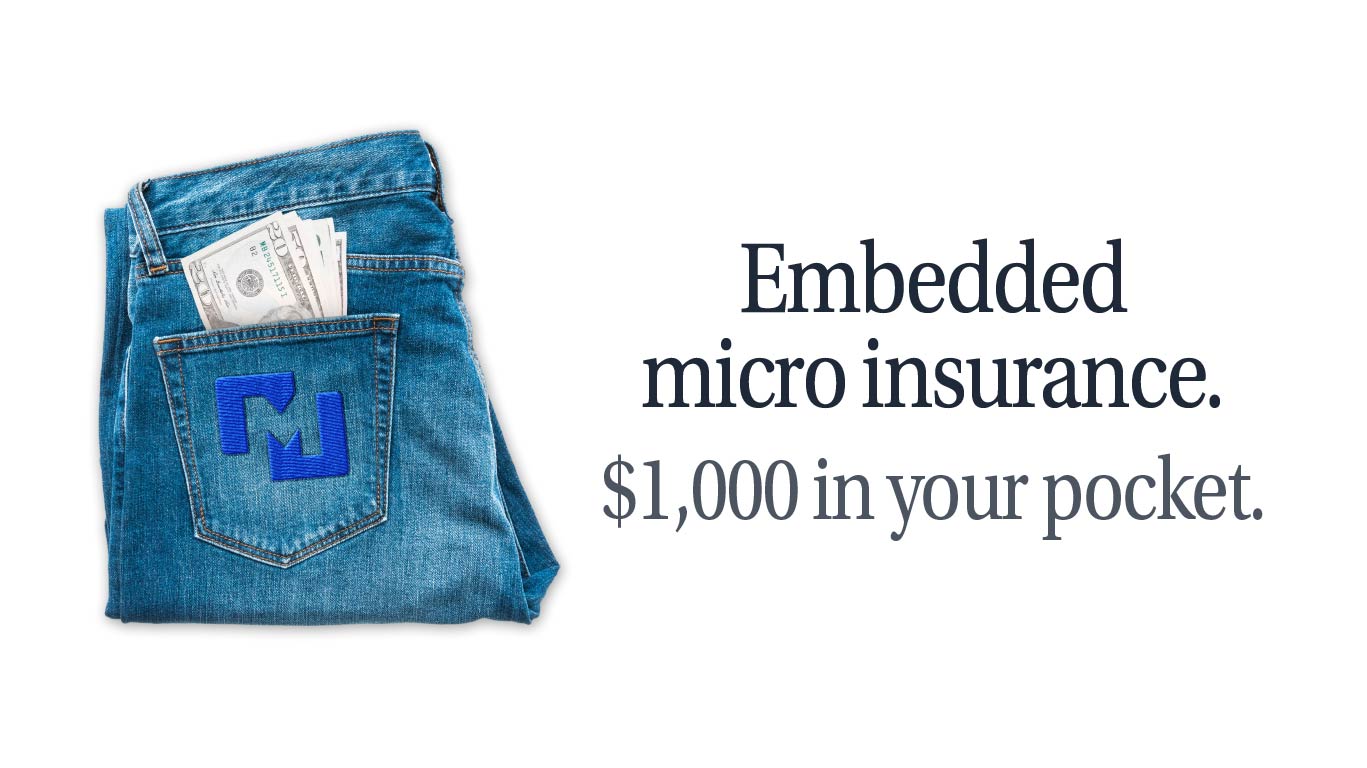
So, inspired by Jobs’ simple words, we like to characterise micro insurance in a similar manner: $1,000 in your pocket.

Hear us out… “$1,000” – coverage levels ideal for typical everyday claims. “In your pocket” – readily accessible policies applied for at the point of sale, via platform and service partner mobile apps and websites, with straightforward, lightweight sign-up processes and claims paid rapidly. Combined, this makes the “$1,000 in your pocket” relevant to the customer.

Micro insurance. The next big thing.

Expanding on this statement in more detail, MIC Global’s micro insurance programs are designed to fill the protection gap that traditional insurers have allowed to develop. Providing coverages for tens or hundreds of dollars for everyday incidents – such as broken gadgets, breaks in income, warranties, travel disruption, and loss of income driven by an event – our digital reinsurance products allow our insurance and platform partners to help their customers in their time of need.

Our embedded micro insurance products are highly accessible through partner platform mobile apps, websites, and subscriptions. We work with our partners to integrate our products into their sales process and create simple, understandable application processes to ensure that their customers can get insured quickly without causing disruption to the partner’s business – in short we add trust and we add value. When a claim arises, customers have convenient access to their coverage direct from the platform they enrolled with. Claims are sent to MIC and can be processed in hours thanks to our AI-powered software, and monetary benefits can be paid to our insurance partners to help the platform’s customers just as quickly. Put simply, this is insurance in a box for our partners.

For example, we have recently partnered with a new neo bank to support their Income Protection product. Customers apply through the bank’s app and the benefit is embedded in the client’s subscription and services. When a subscribed customer needs to make use of the benefit, the system is ready to pay* and support them in their hour of need, putting a $1,000 in to their pocket in an instant.

With simple, relevant, and affordable micro insurance products available at the touch of a button, our partners’ customers have peace of mind that when life happens, they can rely on their protection solution to ensure they have cash in their pocket to get back on track.

Contact us to see how MIC Global can help your business benefit its customers and employees with an embedded micro insurance solution, or simply send us your email address to get started.

* 80% of claims turned around within 48 hours, May–Dec 2023.

Let’s Grow Together

Explore Our Demo